The Problem — Security as an Afterthought
Most Spring Boot APIs ship with:
- Default security settings (which are surprisingly permissive)
- No rate limiting
- Actuator endpoints exposed to the internet
- Verbose error messages that leak internal details
- Credentials in
application.yml committed to Git
Security is treated as “we’ll add it later.” Later never comes. Then you get a CVE notification at 3 AM.
This post maps each OWASP Top 10 vulnerability to concrete Spring Boot mitigations — with code you can copy.
OWASP Top 10 Mapped to Spring Boot
| # | Vulnerability | Spring Boot Mitigation |
|---|
| A01 | Broken Access Control | @PreAuthorize, method security, URL-based rules |
| A02 | Cryptographic Failures | TLS, encrypt at rest, never log secrets |
| A03 | Injection | Parameterized queries, input validation |
| A04 | Insecure Design | Threat modeling, secure defaults |
| A05 | Security Misconfiguration | Actuator lockdown, error handling, no defaults |
| A06 | Vulnerable Components | Dependency scanning, updates |
| A07 | Identification & Auth Failures | Strong passwords, MFA, session management |
| A08 | Software & Data Integrity | Signed JARs, CI/CD security |
| A09 | Security Logging & Monitoring | Structured logging, alerting |
| A10 | Server-Side Request Forgery | URL validation, allowlists |
A01: Broken Access Control
The #1 vulnerability. Users accessing resources they shouldn’t.
Method-Level Security
1
2
3
4
5
| @Configuration
@EnableMethodSecurity
public class SecurityConfig {
// enables @PreAuthorize, @PostAuthorize, @Secured
}
|
1
2
3
4
5
6
7
8
9
10
11
12
13
14
15
16
| @RestController
@RequestMapping("/api/admin")
public class AdminController {
@PreAuthorize("hasRole('ADMIN')")
@GetMapping("/users")
public List<User> getAllUsers() {
return userService.findAll();
}
@PreAuthorize("#userId == authentication.principal.id or hasRole('ADMIN')")
@GetMapping("/users/{userId}")
public User getUser(@PathVariable Long userId) {
return userService.findById(userId);
}
}
|
URL-Based Rules
1
2
3
4
5
6
7
8
9
10
11
| @Bean
public SecurityFilterChain filterChain(HttpSecurity http) throws Exception {
return http
.authorizeHttpRequests(auth -> auth
.requestMatchers("/api/public/**").permitAll()
.requestMatchers("/api/admin/**").hasRole("ADMIN")
.requestMatchers(HttpMethod.DELETE, "/api/**").hasRole("ADMIN")
.anyRequest().authenticated()
)
.build();
}
|
Common Mistakes
- Checking roles in the controller but not the service layer
- Using sequential IDs without ownership checks (IDOR)
- Forgetting that
permitAll() order matters — first match wins
A02: Cryptographic Failures
Never store or transmit sensitive data in plain text.
1
2
3
4
5
| // WRONG — plaintext password in config
spring.datasource.password=mypassword
// RIGHT — externalized secrets
spring.datasource.password=${DB_PASSWORD}
|
Encrypt Sensitive Data
1
2
3
4
5
6
7
8
9
| @Entity
public class User {
// Store hashed, never plain
private String passwordHash;
// Encrypt PII at rest
@Convert(converter = EncryptedStringConverter.class)
private String socialSecurityNumber;
}
|
Force TLS
1
2
3
4
5
6
| server:
ssl:
enabled: true
key-store: classpath:keystore.p12
key-store-password: ${KEYSTORE_PASSWORD}
key-store-type: PKCS12
|
A03: Injection
Spring Data JPA prevents SQL injection by default — if you use it correctly.
1
2
3
4
5
6
7
8
9
10
| // VULNERABLE — string concatenation
@Query("SELECT u FROM User u WHERE u.email = '" + email + "'")
User findByEmailUnsafe(String email);
// SAFE — parameterized query
@Query("SELECT u FROM User u WHERE u.email = :email")
User findByEmail(@Param("email") String email);
// SAFE — Spring Data method naming
User findByEmail(String email);
|
1
2
3
4
5
6
7
8
9
10
11
12
| public record CreateUserRequest(
@NotBlank @Size(max = 100) String name,
@Email @NotBlank String email,
@Size(min = 8, max = 64) String password,
@Pattern(regexp = "^\\+?[1-9]\\d{1,14}$") String phone
) {}
@PostMapping("/users")
public User createUser(@Valid @RequestBody CreateUserRequest request) {
// Input is validated before reaching this point
return userService.create(request);
}
|
Global Validation Error Handler
1
2
3
4
5
6
7
8
9
10
11
12
| @RestControllerAdvice
public class ValidationExceptionHandler {
@ExceptionHandler(MethodArgumentNotValidException.class)
@ResponseStatus(HttpStatus.BAD_REQUEST)
public Map<String, Object> handleValidation(MethodArgumentNotValidException ex) {
Map<String, String> errors = new HashMap<>();
ex.getBindingResult().getFieldErrors()
.forEach(e -> errors.put(e.getField(), e.getDefaultMessage()));
return Map.of("error", "Validation failed", "fields", errors);
}
}
|
A05: Security Misconfiguration
Lock Down Actuator
1
2
3
4
5
6
7
8
9
10
| management:
endpoints:
web:
exposure:
include: health, info, metrics
endpoint:
health:
show-details: never
server:
port: 9090 # Separate port, not accessible from internet
|
Don’t Expose Stack Traces
1
2
3
4
5
| server:
error:
include-message: never
include-stacktrace: never
include-binding-errors: never
|
1
2
3
4
5
6
7
8
9
10
11
12
| @RestControllerAdvice
public class GlobalExceptionHandler {
@ExceptionHandler(Exception.class)
@ResponseStatus(HttpStatus.INTERNAL_SERVER_ERROR)
public Map<String, String> handleGeneric(Exception ex) {
// Log the real error internally
log.error("Unhandled exception", ex);
// Return generic message to client
return Map.of("error", "An unexpected error occurred");
}
}
|
Remove Defaults
1
2
3
4
5
6
7
8
| // Change default error path
server.error.path=/error
// Disable H2 console in production
spring.h2.console.enabled=false
// No default credentials
// NEVER use spring.security.user.name/password in production
|
A07: Cross-Site Scripting (XSS)
For APIs returning JSON, XSS is less common — but if you render HTML or allow user content:
1
2
3
4
5
6
7
8
9
| @Bean
public SecurityFilterChain filterChain(HttpSecurity http) throws Exception {
return http
.headers(headers -> headers
.contentSecurityPolicy(csp ->
csp.policyDirectives("default-src 'self'; script-src 'self'; style-src 'self'"))
)
.build();
}
|
Every Spring Boot API should return these headers:
1
2
3
4
5
6
7
8
9
10
11
12
13
14
15
16
| @Bean
public SecurityFilterChain securityFilterChain(HttpSecurity http) throws Exception {
return http
.headers(headers -> headers
.contentTypeOptions(ct -> {}) // X-Content-Type-Options: nosniff
.frameOptions(frame -> frame.deny()) // X-Frame-Options: DENY
.httpStrictTransportSecurity(hsts -> hsts
.includeSubDomains(true)
.maxAgeInSeconds(31536000)) // Strict-Transport-Security
.contentSecurityPolicy(csp ->
csp.policyDirectives("default-src 'self'"))
.referrerPolicy(ref ->
ref.policy(ReferrerPolicyHeaderWriter.ReferrerPolicy.STRICT_ORIGIN_WHEN_CROSS_ORIGIN))
)
.build();
}
|
| Header | Value | Purpose |
|---|
X-Content-Type-Options | nosniff | Prevents MIME sniffing |
X-Frame-Options | DENY | Prevents clickjacking |
Strict-Transport-Security | max-age=31536000; includeSubDomains | Forces HTTPS |
Content-Security-Policy | default-src 'self' | Controls resource loading |
Referrer-Policy | strict-origin-when-cross-origin | Limits referrer info |
X-XSS-Protection | 0 | Deprecated but still sent |
Rate Limiting
Without rate limiting, a single attacker can DoS your API or brute-force credentials.
Using Bucket4j
1
2
3
4
5
| <dependency>
<groupId>com.bucket4j</groupId>
<artifactId>bucket4j-core</artifactId>
<version>8.10.1</version>
</dependency>
|
1
2
3
4
5
6
7
8
9
10
11
12
13
14
15
16
17
18
19
20
21
22
23
24
25
26
27
28
29
| @Component
public class RateLimitFilter extends OncePerRequestFilter {
private final Map<String, Bucket> buckets = new ConcurrentHashMap<>();
private Bucket createBucket() {
return Bucket.builder()
.addLimit(BandwidthBuilder.builder()
.capacity(100)
.refillGreedy(100, Duration.ofMinutes(1))
.build())
.build();
}
@Override
protected void doFilterInternal(HttpServletRequest request,
HttpServletResponse response,
FilterChain filterChain) throws ServletException, IOException {
String clientIp = request.getRemoteAddr();
Bucket bucket = buckets.computeIfAbsent(clientIp, k -> createBucket());
if (bucket.tryConsume(1)) {
filterChain.doFilter(request, response);
} else {
response.setStatus(HttpStatus.TOO_MANY_REQUESTS.value());
response.getWriter().write("{\"error\": \"Rate limit exceeded\"}");
}
}
}
|
Never trust client input. Validate everything:
1
2
3
4
5
6
7
8
9
10
11
12
13
14
15
16
17
18
| public record ProductRequest(
@NotBlank(message = "Name is required")
@Size(min = 2, max = 200, message = "Name must be 2-200 characters")
String name,
@NotNull(message = "Price is required")
@Positive(message = "Price must be positive")
@Digits(integer = 8, fraction = 2, message = "Price format invalid")
BigDecimal price,
@Size(max = 1000, message = "Description too long")
String description,
@NotBlank(message = "Category is required")
@Pattern(regexp = "^(ELECTRONICS|CLOTHING|FOOD|BOOKS)$",
message = "Invalid category")
String category
) {}
|
Custom Validators
1
2
3
4
5
6
7
8
9
10
11
12
13
14
15
16
17
18
| @Target({ElementType.FIELD})
@Retention(RetentionPolicy.RUNTIME)
@Constraint(validatedBy = SafeHtmlValidator.class)
public @interface SafeHtml {
String message() default "Contains unsafe HTML";
Class<?>[] groups() default {};
Class<? extends Payload>[] payload() default {};
}
public class SafeHtmlValidator implements ConstraintValidator<SafeHtml, String> {
private static final Pattern UNSAFE = Pattern.compile("<script|javascript:|on\\w+=", Pattern.CASE_INSENSITIVE);
@Override
public boolean isValid(String value, ConstraintValidatorContext context) {
if (value == null) return true;
return !UNSAFE.matcher(value).find();
}
}
|
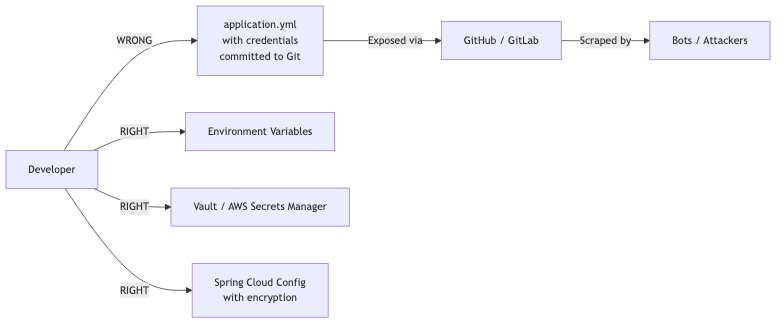
Secrets Management
Never commit secrets to Git. Ever.
graph LR
    A[Developer] -->|WRONG| B[application.yml<br/>with credentials<br/>committed to Git]
    A -->|RIGHT| C[Environment Variables]
    A -->|RIGHT| D[Vault / AWS Secrets Manager]
    A -->|RIGHT| E[Spring Cloud Config<br/>with encryption]
    B -->|Exposed via| F[GitHub / GitLab]
    F -->|Scraped by| G[Bots / Attackers]
Externalize All Secrets
1
2
3
4
5
6
7
8
9
10
11
12
| # application.yml — references, not values
spring:
datasource:
url: ${DB_URL}
username: ${DB_USERNAME}
password: ${DB_PASSWORD}
app:
jwt:
secret: ${JWT_SECRET}
api-keys:
stripe: ${STRIPE_API_KEY}
|
.gitignore
1
2
3
4
5
| .env
*.pem
*.key
application-local.yml
secrets/
|
Production Security Checklist
| Item | Status | Notes |
|---|
| HTTPS enforced (TLS 1.2+) | Required | Redirect HTTP → HTTPS |
| Security headers configured | Required | CSP, HSTS, X-Frame-Options |
| Actuator locked down or on separate port | Required | Never expose /env, /configprops |
| Rate limiting enabled | Required | Per-IP and per-user |
| Input validation on all endpoints | Required | @Valid + custom validators |
| No secrets in Git | Required | Use env vars or vault |
| Error messages don’t leak internals | Required | Generic messages to clients |
| CORS restricted to known origins | Required | Not * in production |
| Authentication on all non-public endpoints | Required | Default deny |
| SQL injection prevented | Required | Parameterized queries only |
| Dependency scanning enabled | Recommended | Dependabot, Snyk, or OWASP Dependency-Check |
| Security logging enabled | Recommended | Log auth failures, access denials |
| JWT expiration set (short-lived) | Recommended | 15 min access, 7 day refresh |
| Password hashing (bcrypt/argon2) | Required | Never MD5/SHA1 |
| CSRF protection for browser clients | Required | Spring Security default |
Common Mistakes
| Mistake | Risk | Fix |
|---|
@CrossOrigin("*") | Any site can call your API | Restrict to known origins |
Actuator at /actuator with no auth | Env vars, beans, heap dumps exposed | Separate port + auth |
spring.security.user.password=admin | Default credentials in prod | External secrets management |
Catching Exception and returning e.getMessage() | Stack traces in responses | Generic error messages |
No @Valid on request bodies | Injection, overflow, invalid data | Always validate |
| JWT with no expiration | Stolen token works forever | Short TTL + refresh token |
| Logging request bodies with passwords | Credentials in log files | Mask sensitive fields |
| H2 console enabled in prod | Remote code execution | spring.h2.console.enabled=false |
| CSRF disabled without understanding why | Cross-site attacks possible | Only disable for pure API + JWT |
Using String for passwords in DTOs | Password stays in memory | Use char[] or clear after use |
Security Testing
Don’t just implement security — verify it:
1
2
3
4
5
6
7
8
9
10
11
12
13
14
15
16
17
18
19
20
21
22
23
24
25
26
27
28
29
30
31
32
33
34
35
36
| @SpringBootTest
@AutoConfigureMockMvc
class SecurityTest {
@Autowired
private MockMvc mockMvc;
@Test
void publicEndpointAccessibleWithoutAuth() throws Exception {
mockMvc.perform(get("/api/public/health"))
.andExpect(status().isOk());
}
@Test
void protectedEndpointReturns401WithoutToken() throws Exception {
mockMvc.perform(get("/api/products"))
.andExpect(status().isUnauthorized());
}
@Test
void adminEndpointReturns403ForRegularUser() throws Exception {
mockMvc.perform(get("/api/admin/users")
.with(jwt().authorities(new SimpleGrantedAuthority("ROLE_USER"))))
.andExpect(status().isForbidden());
}
@Test
void invalidInputReturns400() throws Exception {
mockMvc.perform(post("/api/products")
.contentType(MediaType.APPLICATION_JSON)
.content("""
{"name": "", "price": -1}
"""))
.andExpect(status().isBadRequest());
}
}
|
References