Spring Boot + gRPC — High-Performance Inter-Service Communication
Build high-performance microservices with Spring Boot and gRPC. Covers Protocol Buffers, unary and server-streaming RPCs, the grpc-spring-boot-starter, error handling, deadlines, and performance comparison with REST.
The Problem
Microservices talk to each other constantly. In most Spring Boot projects, that means REST over HTTP/1.1 with JSON payloads. It works, but the overhead adds up:
- Text-based serialization — JSON is human-readable but expensive to parse. Every field name is sent on every request.
- One request per connection — HTTP/1.1 opens a new connection (or waits for an existing one) for each call. Head-of-line blocking is real.
- No contract enforcement — OpenAPI specs are optional and often drift from the actual implementation.
- No streaming — Polling or WebSockets are bolted on as afterthoughts.
For internal service-to-service calls where humans never read the payload, we can do much better.
What Is gRPC?
gRPC is a high-performance RPC framework originally developed at Google. It uses Protocol Buffers (protobuf) for serialization and HTTP/2 for transport.
sequenceDiagram
    participant Client as gRPC Client
    participant Server as gRPC Server

    Client->>Server: HTTP/2 stream — binary protobuf request
    Server-->>Client: HTTP/2 stream — binary protobuf response
    Note over Client,Server: Single TCP connection, multiplexed streams
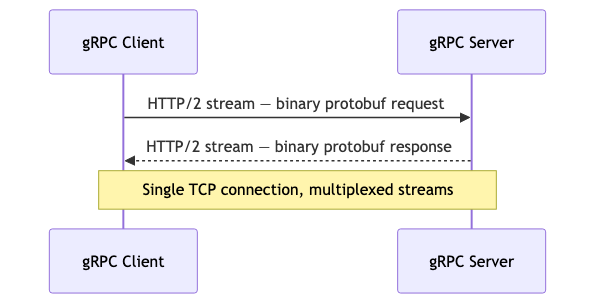
Key properties:
| Feature | Description |
|---|---|
| Protocol Buffers | Binary serialization — 3-10x smaller than JSON, 20-100x faster to parse |
| HTTP/2 | Multiplexed streams over a single TCP connection, header compression |
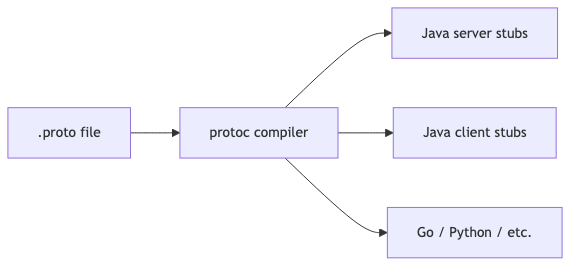
| Code generation | Strongly typed client and server stubs generated from .proto files |
| Streaming | First-class support for unary, server-streaming, client-streaming, and bidirectional streaming |
| Deadlines | Built-in timeout propagation across service boundaries |
graph LR
    A[.proto file] --> B[protoc compiler]
    B --> C[Java server stubs]
    B --> D[Java client stubs]
    B --> E[Go / Python / etc.]
What We Are Building
A multi-module Spring Boot project with:
- proto — Shared
.protodefinitions and generated stubs - grpc-server — Exposes a
PaymentServiceover gRPC on port 9090 - grpc-client — REST API (port 8080) that calls the gRPC server internally
flowchart LR
    Browser["Browser / curl"] -->|REST HTTP| Client[grpc-client :8080]
    Client -->|gRPC HTTP/2| Server[grpc-server :9090]

Step 1: Define the Proto
Create proto/src/main/proto/payment.proto:
1
2
3
4
5
6
7
8
9
10
11
12
13
14
15
16
17
18
19
20
21
22
23
24
25
26
27
28
29
30
31
32
33
syntax = "proto3";

option java_multiple_files = true;
option java_package = "com.anupam.grpc.proto";
option java_outer_classname = "PaymentProto";

package payment;

message PaymentRequest {
  string payment_id = 1;
}

message ListPaymentsRequest {
  string user_id = 1;
  int32 page_size = 2;
}

message PaymentResponse {
  string payment_id = 1;
  string user_id = 2;
  double amount = 3;
  string currency = 4;
  string status = 5;
  string created_at = 6;
}

service PaymentService {
  // Unary RPC — one request, one response
  rpc GetPayment(PaymentRequest) returns (PaymentResponse);

  // Server streaming — one request, stream of responses
  rpc ListPayments(ListPaymentsRequest) returns (stream PaymentResponse);
}
The protobuf-maven-plugin compiles this into Java classes during mvn compile:
1
2
3
4
5
6
7
8
9
10
11
12
13
14
15
16
17
18
19
20
21
22
<plugin>
    <groupId>org.xolstice.maven.plugins</groupId>
    <artifactId>protobuf-maven-plugin</artifactId>
    <version>0.6.1</version>
    <configuration>
        <protocArtifact>
            com.google.protobuf:protoc:${protobuf.version}:exe:${os.detected.classifier}
        </protocArtifact>
        <pluginId>grpc-java</pluginId>
        <pluginArtifact>
            io.grpc:protoc-gen-grpc-java:${grpc.version}:exe:${os.detected.classifier}
        </pluginArtifact>
    </configuration>
    <executions>
        <execution>
            <goals>
                <goal>compile</goal>
                <goal>compile-custom</goal>
            </goals>
        </execution>
    </executions>
</plugin>
After compilation, you get:
PaymentRequest,PaymentResponse,ListPaymentsRequest— message classesPaymentServiceGrpc— base classes for server implementation and client stubs
Step 2: Server Implementation
The grpc-server module uses net.devh:grpc-server-spring-boot-starter to integrate gRPC into Spring Boot seamlessly.
Application class
1
2
3
4
5
6
@SpringBootApplication
public class GrpcServerApplication {
    public static void main(String[] args) {
        SpringApplication.run(GrpcServerApplication.class, args);
    }
}
PaymentGrpcService
Annotate with @GrpcService — the starter auto-registers it with the gRPC server:
1
2
3
4
5
6
7
8
9
10
11
12
13
14
15
16
17
18
19
20
21
22
23
24
25
26
27
28
29
30
31
32
33
34
35
36
37
38
39
40
41
42
43
44
@GrpcService
public class PaymentGrpcService extends PaymentServiceGrpc.PaymentServiceImplBase {

    private final Map<String, PaymentResponse> payments = new ConcurrentHashMap<>();

    @Override
    public void getPayment(PaymentRequest request,
                           StreamObserver<PaymentResponse> responseObserver) {
        String paymentId = request.getPaymentId();

        if (paymentId == null || paymentId.isBlank()) {
            responseObserver.onError(Status.INVALID_ARGUMENT
                    .withDescription("Payment ID must not be empty")
                    .asRuntimeException());
            return;
        }

        PaymentResponse payment = payments.get(paymentId);

        if (payment == null) {
            responseObserver.onError(Status.NOT_FOUND
                    .withDescription("Payment not found: " + paymentId)
                    .asRuntimeException());
            return;
        }

        responseObserver.onNext(payment);
        responseObserver.onCompleted();
    }

    @Override
    public void listPayments(ListPaymentsRequest request,
                             StreamObserver<PaymentResponse> responseObserver) {
        String userId = request.getUserId();
        int pageSize = request.getPageSize() > 0 ? request.getPageSize() : 10;

        payments.values().stream()
                .filter(p -> p.getUserId().equals(userId))
                .limit(pageSize)
                .forEach(responseObserver::onNext);

        responseObserver.onCompleted();
    }
}
Configuration
1
2
3
4
5
6
7
spring:
  application:
    name: grpc-server

grpc:
  server:
    port: 9090
The pattern for every gRPC method:
- Validate the request
- Do the work
- Call
responseObserver.onNext(response)(once for unary, multiple times for streaming) - Call
responseObserver.onCompleted() - On failure, call
responseObserver.onError(statusException)
Step 3: Client Implementation
The grpc-client module uses net.devh:grpc-client-spring-boot-starter to inject gRPC stubs.
PaymentClientService
1
2
3
4
5
6
7
8
9
10
11
12
13
14
15
16
17
18
19
20
21
22
23
24
25
26
27
28
29
@Service
public class PaymentClientService {

    private static final Logger log = LoggerFactory.getLogger(PaymentClientService.class);

    @GrpcClient("payment-service")
    private PaymentServiceGrpc.PaymentServiceBlockingStub paymentStub;

    public PaymentResponse getPayment(String paymentId) {
        log.info("Requesting payment: {}", paymentId);
        PaymentRequest request = PaymentRequest.newBuilder()
                .setPaymentId(paymentId)
                .build();
        return paymentStub.getPayment(request);
    }

    public List<PaymentResponse> listPayments(String userId, int pageSize) {
        log.info("Listing payments for user: {}", userId);
        ListPaymentsRequest request = ListPaymentsRequest.newBuilder()
                .setUserId(userId)
                .setPageSize(pageSize)
                .build();

        Iterator<PaymentResponse> iterator = paymentStub.listPayments(request);
        List<PaymentResponse> payments = new ArrayList<>();
        iterator.forEachRemaining(payments::add);
        return payments;
    }
}
The @GrpcClient("payment-service") annotation injects a stub configured by the name in application.yml.
REST Controller
Expose gRPC results as a standard REST API:
1
2
3
4
5
6
7
8
9
10
11
12
13
14
15
16
17
18
19
20
21
22
23
24
25
26
27
28
29
30
31
32
33
34
@RestController
@RequestMapping("/api/payments")
public class PaymentController {

    private final PaymentClientService paymentClientService;

    public PaymentController(PaymentClientService paymentClientService) {
        this.paymentClientService = paymentClientService;
    }

    @GetMapping("/{paymentId}")
    public ResponseEntity<?> getPayment(@PathVariable String paymentId) {
        try {
            PaymentResponse response = paymentClientService.getPayment(paymentId);
            return ResponseEntity.ok(toMap(response));
        } catch (StatusRuntimeException e) {
            return handleGrpcError(e);
        }
    }

    @GetMapping
    public ResponseEntity<?> listPayments(
            @RequestParam String userId,
            @RequestParam(defaultValue = "10") int pageSize) {
        try {
            List<PaymentResponse> responses =
                    paymentClientService.listPayments(userId, pageSize);
            return ResponseEntity.ok(responses.stream()
                    .map(this::toMap).toList());
        } catch (StatusRuntimeException e) {
            return handleGrpcError(e);
        }
    }
}
Client Configuration
1
2
3
4
5
6
7
8
9
10
11
12
spring:
  application:
    name: grpc-client

server:
  port: 8080

grpc:
  client:
    payment-service:
      address: static://localhost:9090
      negotiation-type: plaintext
Step 4: Server Streaming
The ListPayments RPC demonstrates server streaming. Instead of returning a single response, the server sends multiple PaymentResponse messages over the same HTTP/2 stream:
sequenceDiagram
    participant Client as grpc-client
    participant Server as grpc-server

    Client->>Server: ListPaymentsRequest (userId=USER-1)
    Server-->>Client: PaymentResponse (PAY-001)
    Server-->>Client: PaymentResponse (PAY-002)
    Server-->>Client: PaymentResponse (PAY-003)
    Server-->>Client: Stream completed
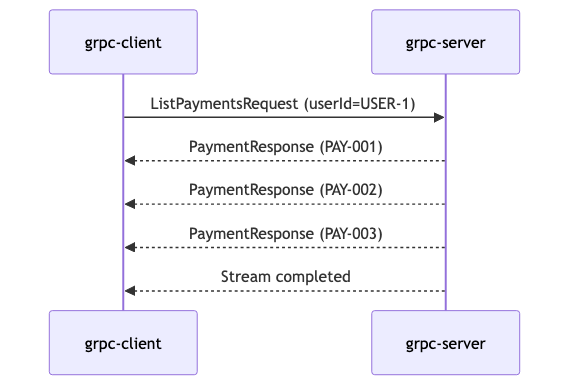
On the server side, you call onNext() for each item:
1
2
3
4
5
6
payments.values().stream()
        .filter(p -> p.getUserId().equals(userId))
        .limit(pageSize)
        .forEach(responseObserver::onNext);

responseObserver.onCompleted();
On the client side, you receive an Iterator:
1
2
Iterator<PaymentResponse> iterator = paymentStub.listPayments(request);
iterator.forEachRemaining(payments::add);
This is powerful for:
- Large result sets — Stream rows instead of buffering the entire list in memory
- Real-time feeds — Push data as it becomes available
- Progress updates — Report processing status incrementally
gRPC vs REST Comparison
| Aspect | REST + JSON | gRPC + Protobuf |
|---|---|---|
| Serialization | JSON (text, ~verbose) | Protobuf (binary, compact) |
| Transport | HTTP/1.1 (one req/conn) | HTTP/2 (multiplexed streams) |
| Payload size | Larger (field names repeated) | 3-10x smaller |
| Parse speed | Slower (text parsing) | 20-100x faster |
| Code generation | Optional (OpenAPI) | Built-in and required |
| Streaming | Workarounds (SSE, WebSocket) | Native (4 patterns) |
| Browser support | Native | Requires grpc-web proxy |
| Human readability | Easy to debug with curl | Binary — needs tooling |
| Contract | Can drift from spec | Proto file is the contract |
| Tooling | Mature ecosystem | Growing (grpcurl, Postman) |
When to use gRPC:
- Internal service-to-service communication
- High-throughput, low-latency requirements
- Streaming use cases
- Polyglot environments (one proto, many languages)
When to stick with REST:
- Public APIs consumed by browsers
- Simple CRUD with few calls
- Team familiarity and tooling preferences
Error Handling
gRPC uses status codes instead of HTTP status codes. Map them to HTTP when exposing a REST facade:
| gRPC Status | HTTP Status | Typical Use |
|---|---|---|
OK | 200 | Success |
INVALID_ARGUMENT | 400 | Bad request data |
NOT_FOUND | 404 | Resource doesn’t exist |
ALREADY_EXISTS | 409 | Duplicate creation |
PERMISSION_DENIED | 403 | Insufficient permissions |
UNAUTHENTICATED | 401 | Missing/invalid credentials |
DEADLINE_EXCEEDED | 504 | Timeout |
UNAVAILABLE | 503 | Server temporarily down |
INTERNAL | 500 | Unexpected server error |
In the server, return errors with meaningful descriptions:
1
2
3
responseObserver.onError(Status.NOT_FOUND
        .withDescription("Payment not found: " + paymentId)
        .asRuntimeException());
In the client controller, translate to HTTP:
1
2
3
4
5
6
7
8
9
10
11
12
13
private ResponseEntity<Map<String, String>> handleGrpcError(StatusRuntimeException e) {
    HttpStatus httpStatus = switch (e.getStatus().getCode()) {
        case NOT_FOUND -> HttpStatus.NOT_FOUND;
        case INVALID_ARGUMENT -> HttpStatus.BAD_REQUEST;
        case PERMISSION_DENIED -> HttpStatus.FORBIDDEN;
        case UNAUTHENTICATED -> HttpStatus.UNAUTHORIZED;
        case DEADLINE_EXCEEDED -> HttpStatus.GATEWAY_TIMEOUT;
        case UNAVAILABLE -> HttpStatus.SERVICE_UNAVAILABLE;
        default -> HttpStatus.INTERNAL_SERVER_ERROR;
    };
    return ResponseEntity.status(httpStatus)
            .body(Map.of("error", e.getStatus().getDescription()));
}
Deadlines
Always set deadlines to avoid hanging calls:
1
2
PaymentServiceGrpc.PaymentServiceBlockingStub stubWithDeadline =
        paymentStub.withDeadlineAfter(5, TimeUnit.SECONDS);
If the server doesn’t respond within the deadline, the client receives DEADLINE_EXCEEDED.
Common Problems
| Problem | Cause | Solution |
|---|---|---|
UNAVAILABLE: io exception | Server not running or wrong port | Verify grpc.server.port matches client address |
UNIMPLEMENTED | Method not overridden in service impl | Extend the correct ImplBase class and override the method |
Could not find protoc | OS classifier not detected | Add os-maven-plugin as a build extension |
| Stubs not generated | Missing compile-custom goal | Ensure both compile and compile-custom goals are configured |
DEADLINE_EXCEEDED | Slow server or network issues | Increase deadline or optimize server logic |
ClassNotFoundException for proto classes | Proto module not built first | Run mvn install from the parent to build modules in order |
negotiation-type error | TLS mismatch | Use plaintext for local dev, tls for production |
Full Working Example
The complete source code for this project is available on GitHub:
github.com/AnupamSinha/spring-boot-examples/tree/main/14-grpc
1
2
3
4
5
6
7
8
9
10
11
12
13
14
# Clone and build
git clone https://github.com/AnupamSinha/spring-boot-examples/tree/main/14-grpc
cd spring-boot-grpc
mvn clean install

# Terminal 1 — start gRPC server
cd grpc-server && mvn spring-boot:run

# Terminal 2 — start REST client
cd grpc-client && mvn spring-boot:run

# Terminal 3 — test
curl http://localhost:8080/api/payments/PAY-001
curl "http://localhost:8080/api/payments?userId=USER-1&pageSize=10"