Quarkus vs Spring Boot — A Practical Comparison for 2026
An honest side-by-side comparison of Quarkus and Spring Boot in 2026. Covers startup time, memory usage, developer experience, ecosystem, native compilation, and when to choose which — from someone who uses both.
The Question — Which Framework?
If you’re starting a new Java microservice in 2026, you’ve got a genuine choice to make. Spring Boot has been the default for a decade. Quarkus arrived as the “Kubernetes-native” alternative and has matured rapidly. Both target Java 21, both support GraalVM native images, and both have strong communities.
This isn’t a “which is better” post — it’s a “when to choose which” post, backed by code you can compare side by side.
Architecture Differences
The fundamental philosophical difference: when work happens.
flowchart LR
    subgraph Spring Boot
        direction TB
        S1[Application Starts] --> S2[Classpath Scanning]
        S2 --> S3[Bean Discovery]
        S3 --> S4[Proxy Generation]
        S4 --> S5[Dependency Injection]
        S5 --> S6[Ready to Serve]
    end

    subgraph Quarkus
        direction TB
        Q1[Build Time] --> Q2[Classpath Scanning]
        Q2 --> Q3[Bean Discovery]
        Q3 --> Q4[Bytecode Generation]
        Q4 --> Q5[Runtime Start]
        Q5 --> Q6[Minimal DI Wiring]
        Q6 --> Q7[Ready to Serve]
    end

Spring Boot does most of its heavy lifting at runtime — scanning, proxy generation, condition evaluation. Quarkus moves as much as possible to build time using its extension framework. The result: dramatically faster startup and lower memory at the cost of longer builds.
| Aspect | Spring Boot | Quarkus |
|---|---|---|
| DI resolution | Runtime | Build time |
| Configuration | Runtime conditions | Build-time augmentation |
| Proxy generation | Runtime (CGLIB/JDK) | Build time (bytecode) |
| Reflection | Heavy use | Minimized (records metadata at build) |
| Hot reload | Spring DevTools (restart) | Quarkus Dev Mode (instant) |
Side-by-Side Code
Let’s build the same simple REST API in both frameworks: a BookController with CRUD operations.
REST Endpoint
Spring Boot:
1
2
3
4
5
6
7
8
9
10
11
12
13
14
15
16
17
18
19
20
21
22
23
24
25
26
27
28
@RestController
@RequestMapping("/api/books")
public class BookController {

    private final BookService bookService;

    public BookController(BookService bookService) {
        this.bookService = bookService;
    }

    @GetMapping
    public List<Book> findAll() {
        return bookService.findAll();
    }

    @GetMapping("/{id}")
    public ResponseEntity<Book> findById(@PathVariable Long id) {
        return bookService.findById(id)
                .map(ResponseEntity::ok)
                .orElse(ResponseEntity.notFound().build());
    }

    @PostMapping
    @ResponseStatus(HttpStatus.CREATED)
    public Book create(@Valid @RequestBody Book book) {
        return bookService.save(book);
    }
}
Quarkus:
1
2
3
4
5
6
7
8
9
10
11
12
13
14
15
16
17
18
19
20
21
22
23
24
25
26
27
28
29
30
31
@Path("/api/books")
@Produces(MediaType.APPLICATION_JSON)
@Consumes(MediaType.APPLICATION_JSON)
public class BookResource {

    private final BookService bookService;

    @Inject
    public BookResource(BookService bookService) {
        this.bookService = bookService;
    }

    @GET
    public List<Book> findAll() {
        return bookService.findAll();
    }

    @GET
    @Path("/{id}")
    public Response findById(@PathParam("id") Long id) {
        return bookService.findById(id)
                .map(book -> Response.ok(book).build())
                .orElse(Response.status(Status.NOT_FOUND).build());
    }

    @POST
    public Response create(@Valid Book book) {
        Book created = bookService.save(book);
        return Response.status(Status.CREATED).entity(created).build();
    }
}
Dependency Injection
Spring Boot:
1
2
3
4
5
6
7
8
9
10
11
@Service
public class BookService {

    private final BookRepository bookRepository;

    public BookService(BookRepository bookRepository) {
        this.bookRepository = bookRepository;
    }

    // constructor injection — no annotation needed (single constructor)
}
Quarkus:
1
2
3
4
5
6
7
8
9
10
11
12
@ApplicationScoped
public class BookService {

    private final BookRepository bookRepository;

    @Inject
    public BookService(BookRepository bookRepository) {
        this.bookRepository = bookRepository;
    }

    // CDI-based — @Inject required on constructor
}
Configuration
Spring Boot (application.yml):
1
2
3
4
5
6
7
8
spring:
  datasource:
    url: jdbc:postgresql://localhost:5432/books
    username: ${DB_USER:postgres}
    password: ${DB_PASS:secret}
  jpa:
    hibernate:
      ddl-auto: validate
Quarkus (application.properties):
1
2
3
4
5
quarkus.datasource.db-kind=postgresql
quarkus.datasource.jdbc.url=jdbc:postgresql://localhost:5432/books
quarkus.datasource.username=${DB_USER:postgres}
quarkus.datasource.password=${DB_PASS:secret}
quarkus.hibernate-orm.database.generation=validate
Data Access
Spring Boot (Spring Data JPA):
1
2
3
public interface BookRepository extends JpaRepository<Book, Long> {
    List<Book> findByAuthor(String author);
}
Quarkus (Panache):
1
2
3
4
5
6
@ApplicationScoped
public class BookRepository implements PanacheRepository<Book> {
    public List<Book> findByAuthor(String author) {
        return find("author", author).list();
    }
}
Performance Benchmarks
Tested on: Apple M3 Pro, 18GB RAM, Java 21.0.3, Spring Boot 3.5.0, Quarkus 3.16.0
| Metric | Spring Boot (JVM) | Spring Boot (Native) | Quarkus (JVM) | Quarkus (Native) |
|---|---|---|---|---|
| Startup time | 2.1s | 0.08s | 0.9s | 0.02s |
| RSS memory (idle) | 280 MB | 72 MB | 145 MB | 32 MB |
| RSS memory (load) | 420 MB | 148 MB | 230 MB | 78 MB |
| Throughput (req/s) | 48,200 | 42,800 | 47,500 | 41,200 |
| Build time | 8s | 3m 20s | 12s | 2m 45s |
| JAR size | 42 MB | N/A | 38 MB | N/A |
| Native binary size | N/A | 98 MB | N/A | 72 MB |
Key takeaways:
- JVM throughput is comparable — the performance difference is mostly startup + memory.
- Native images trade throughput for startup/memory — JIT optimizes better over time.
- Quarkus native compiles faster — less reflection to configure.
Developer Experience
| Feature | Spring Boot | Quarkus |
|---|---|---|
| Hot reload | DevTools (restarts JVM, ~2s) | Dev Mode (instant, no restart) |
| IDE support | Excellent (IntelliJ, Eclipse) | Good (IntelliJ plugin improving) |
| Documentation | Extensive, mature | Good, well-organized |
| Stack Overflow answers | Very high | Growing |
| Testing | @SpringBootTest, Testcontainers | @QuarkusTest, Dev Services |
| Dev Services (auto-DB) | Spring Boot 3.1+ Docker Compose | Built-in since Quarkus 2.0 |
| CLI tool | Spring Initializr (web) | quarkus CLI (powerful) |
| Continuous testing | Separate (IDE/CI) | Built into Dev Mode |
| OpenAPI generation | SpringDoc (add-on) | Built-in extension |
The developer experience gap has narrowed significantly. Quarkus Dev Mode still leads for inner-loop speed. Spring Boot’s ecosystem maturity still wins for “I need a library for X.”
Ecosystem & Libraries
| Need | Spring Boot | Quarkus |
|---|---|---|
| REST clients | RestClient, WebClient, Feign | REST Client (MicroProfile), Vert.x |
| Messaging | Spring Kafka, Spring AMQP | SmallRye Reactive Messaging |
| Security | Spring Security | Quarkus Security, Keycloak |
| GraphQL | Spring for GraphQL | SmallRye GraphQL |
| gRPC | grpc-spring-boot-starter | quarkus-grpc |
| Scheduling | @Scheduled | @Scheduled (quarkus-scheduler) |
| Caching | Spring Cache + any provider | quarkus-cache (Caffeine) |
| Health checks | Actuator | SmallRye Health |
| Metrics | Micrometer | Micrometer (via Quarkus extension) |
| Observability | Micrometer Tracing | OpenTelemetry (first-class) |
Spring Boot wins on breadth — if a Java library exists, there’s probably a Spring integration. Quarkus wins on coherent defaults — extensions are designed to work together with minimal configuration.
Native Compilation
Spring Boot with Spring AOT
1
2
3
4
5
# Build native image
./mvnw -Pnative native:compile

# Or with Buildpacks (no local GraalVM needed)
./mvnw spring-boot:build-image -Dspring-boot.build-image.imageName=myapp:native
Spring AOT processes @Conditional annotations at build time and generates reflection configuration. You may still need reflect-config.json for libraries that use reflection heavily.
Quarkus Native
1
2
3
4
5
# Build native image
./mvnw package -Dnative

# With container build (no local GraalVM needed)
./mvnw package -Dnative -Dquarkus.native.container-build=true
Quarkus was designed for native from day one. Extensions register reflection automatically. You rarely need manual configuration.
Comparison
| Aspect | Spring Native | Quarkus Native |
|---|---|---|
| Configuration effort | Medium (improving) | Low |
| Library compatibility | ~90% of Spring ecosystem | Extensions are native-ready |
| Build time | Longer (more reflection to process) | Shorter |
| Runtime performance | Good | Good |
| Debugging native issues | Harder | Easier (better error messages) |
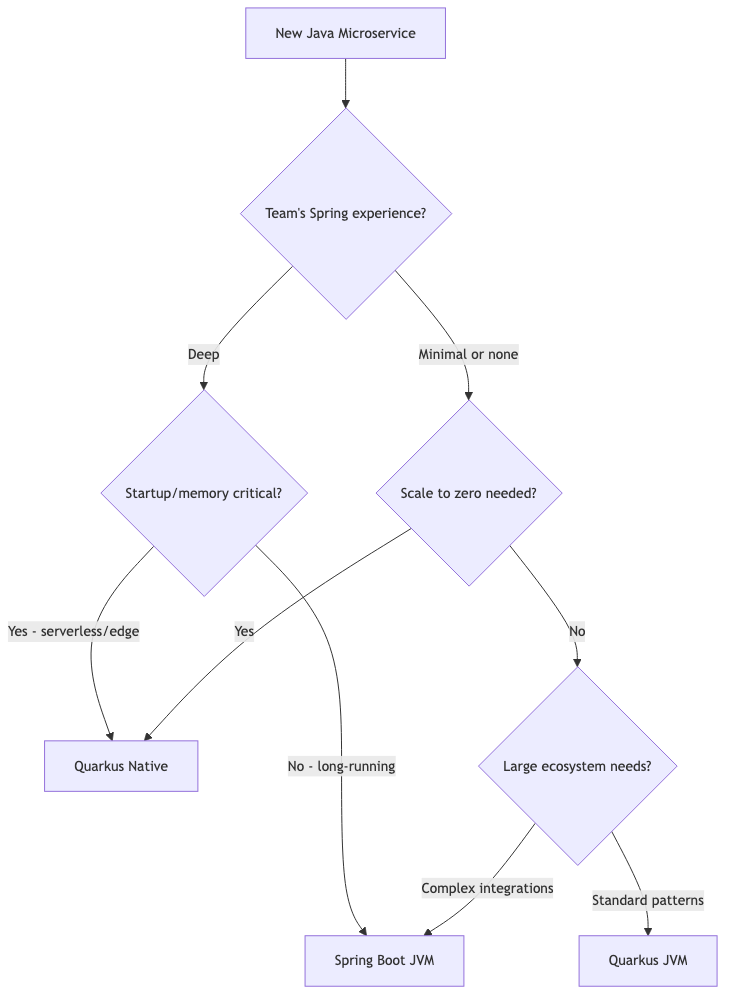
When to Choose Which
flowchart TD
    A[New Java Microservice] --> B{Team's Spring experience?}
    B -->|Deep| C{Startup/memory critical?}
    B -->|Minimal or none| D{Scale to zero needed?}

    C -->|Yes - serverless/edge| E[Quarkus Native]
    C -->|No - long-running| F[Spring Boot JVM]

    D -->|Yes| E
    D -->|No| G{Large ecosystem needs?}

    G -->|Complex integrations| F
    G -->|Standard patterns| H[Quarkus JVM]
Decision Matrix
| Scenario | Recommendation | Why |
|---|---|---|
| Enterprise with Spring teams | Spring Boot | Leverage existing expertise |
| Serverless / AWS Lambda | Quarkus Native | Fastest cold start |
| Kubernetes scale-to-zero | Quarkus Native | Memory + startup |
| Long-running monolith | Spring Boot | Ecosystem, JIT optimization |
| New team, greenfield | Either (evaluate both) | Both are excellent |
| Event-driven reactive | Quarkus | Vert.x integration, SmallRye |
| Complex security requirements | Spring Boot | Spring Security maturity |
| CLI / short-lived processes | Quarkus Native | Sub-second startup |
Can They Coexist?
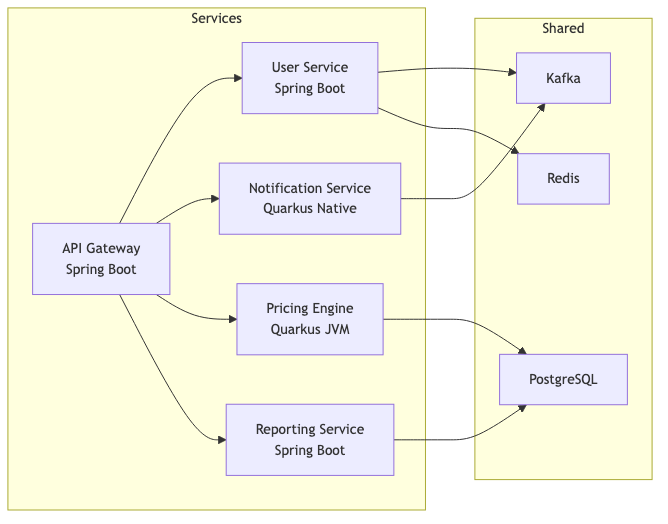
Yes. In a microservices architecture, there’s no rule that says every service must use the same framework. A practical pattern:
flowchart LR
    subgraph Services
        A[API Gateway<br>Spring Boot] --> B[User Service<br>Spring Boot]
        A --> C[Notification Service<br>Quarkus Native]
        A --> D[Pricing Engine<br>Quarkus JVM]
        A --> E[Reporting Service<br>Spring Boot]
    end

    subgraph Shared
        F[Kafka]
        G[PostgreSQL]
        H[Redis]
    end

    B --> F
    C --> F
    D --> G
    E --> G
    B --> H
Guidelines for coexistence:
- Use language-agnostic communication (REST, gRPC, Kafka) — not framework-specific.
- Shared libraries should be plain Java (no Spring/CDI annotations).
- Standardize on OpenTelemetry for observability across both.
- Use the same build pipeline (Maven/Gradle) — both frameworks support both.