Spring Modulith — Building Modular Monoliths That Actually Stay Modular
A hands-on guide to Spring Modulith for building well-structured modular monoliths. Covers module boundaries, enforced encapsulation, event-driven communication, testing module isolation, and when this architecture beats microservices.
The Problem with Monoliths (and Microservices)
If you’re starting your career, you’ll hear two things constantly: “monoliths are bad” and “microservices are the answer.” Neither is fully true. Let me show you what actually happens in real projects.
The Big Ball of Mud Monolith
Everything calls everything. Want to change how orders work? Surprise — it breaks notifications, breaks reporting, and breaks the admin dashboard.
graph TD
    A[Order Module] --> B[Payment Module]
    A --> C[Notification Module]
    A --> D[Inventory Module]
    B --> A
    B --> C
    C --> D
    D --> A
    D --> B
    C --> A

    style A fill:#ff6b6b,color:#fff
    style B fill:#ff6b6b,color:#fff
    style C fill:#ff6b6b,color:#fff
    style D fill:#ff6b6b,color:#fff
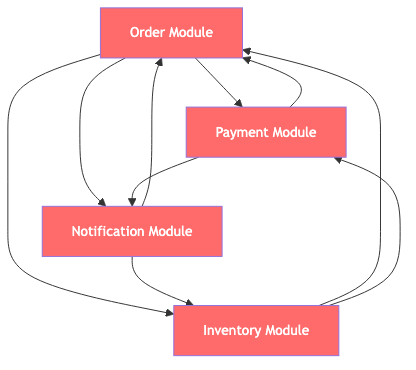
Every module depends on every other module. Change one thing, break five things. This is what “spaghetti code” looks like at the architecture level.
Premature Microservices
You split into 15 services before understanding your domain boundaries. Now you have the same tangled dependencies — just across a network with added latency, failure modes, and deployment complexity.
graph TD
    subgraph Network Boundary
        A[Order Service] -->|HTTP| B[Payment Service]
        A -->|HTTP| C[Notification Service]
        A -->|HTTP| D[Inventory Service]
        B -->|HTTP| E[Audit Service]
        C -->|HTTP| F[Template Service]
        D -->|HTTP| G[Warehouse Service]
    end

    X[Load Balancer] --> A
    Y[(Database per Service x7)] --- A
    Y --- B
    Y --- C
    Y --- D

    style X fill:#feca57,color:#333
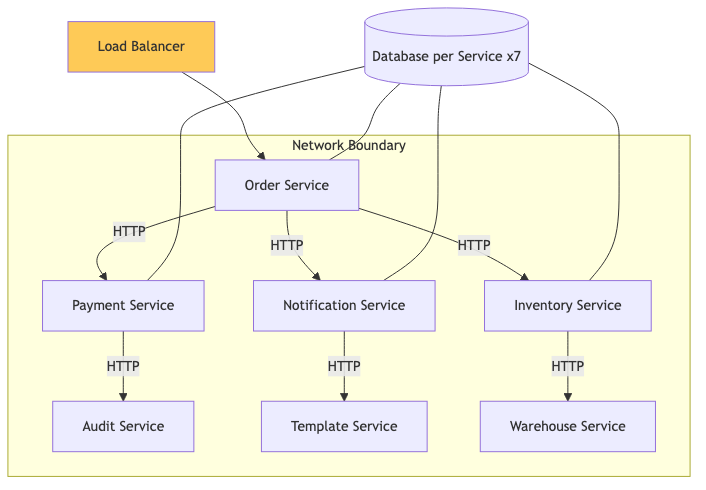
Same mess, now with network calls, 7 databases, and a DevOps team crying in the corner.
The Middle Path: Modular Monolith
graph TD
    subgraph Single Deployment Unit
        subgraph Order Module
            A[OrderService]
            A2[OrderController]
        end
        subgraph Payment Module
            B[PaymentService]
        end
        subgraph Inventory Module
            C[InventoryService]
        end
        subgraph Notification Module
            D[NotificationService]
        end
    end

    A -->|event| B
    A -->|event| C
    A -->|event| D

    style A fill:#2ed573,color:#fff
    style B fill:#2ed573,color:#fff
    style C fill:#2ed573,color:#fff
    style D fill:#2ed573,color:#fff
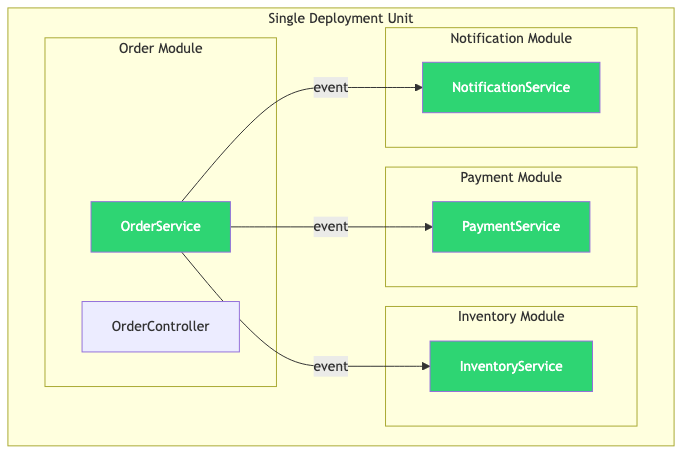
One deployment. Clear boundaries. Modules talk through events, not tangled direct calls.
Think of it like an apartment building: everyone lives in one building (monolith), but each apartment has its own walls, lock, and front door (modules). You don’t walk through someone’s kitchen to get to your bathroom.
What Spring Modulith Provides
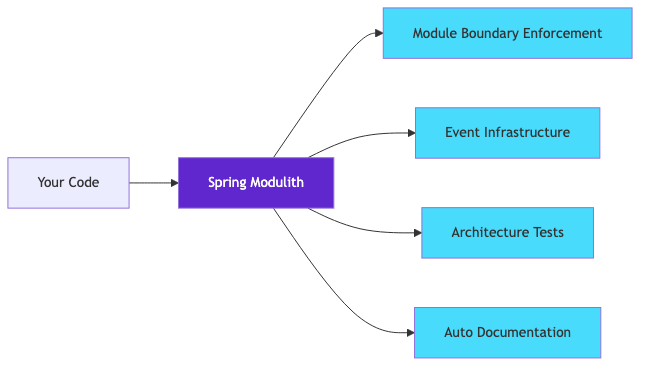
Spring Modulith is an opinionated framework built on Spring Boot that:
- Defines module boundaries based on package structure
- Enforces encapsulation — modules can’t access each other’s internals
- Provides event-based communication between modules
- Verifies architecture with automated tests
- Generates documentation of module dependencies
graph LR
    A[Your Code] --> B[Spring Modulith]
    B --> C[Module Boundary Enforcement]
    B --> D[Event Infrastructure]
    B --> E[Architecture Tests]
    B --> F[Auto Documentation]

    style B fill:#5f27cd,color:#fff
    style C fill:#48dbfb,color:#333
    style D fill:#48dbfb,color:#333
    style E fill:#48dbfb,color:#333
    style F fill:#48dbfb,color:#333
Project Structure
Spring Modulith uses a convention-over-configuration approach. Think of your package structure as a floor plan — top-level packages under your main application package are modules:
1
2
3
4
5
6
7
8
9
10
11
12
13
14
15
16
17
18
19
20
21
22
23
24
25
26
27
com.myapp/
├── MyApplication.java              ← Main class
├── order/                          ← Order module
│   ├── Order.java                  ← Public API (exposed)
│   ├── OrderService.java           ← Public API (exposed)
│   ├── OrderController.java        ← Public API (exposed)
│   └── internal/                   ← Internal (hidden from other modules)
│       ├── OrderRepository.java
│       ├── OrderValidator.java
│       └── OrderMapper.java
├── inventory/                      ← Inventory module
│   ├── InventoryService.java
│   ├── StockLevel.java
│   └── internal/
│       ├── InventoryRepository.java
│       └── WarehouseClient.java
├── payment/                        ← Payment module
│   ├── PaymentService.java
│   ├── PaymentResult.java
│   └── internal/
│       ├── StripeClient.java
│       └── PaymentRepository.java
└── notification/                   ← Notification module
    ├── NotificationService.java
    └── internal/
        ├── EmailSender.java
        └── TemplateEngine.java
Here’s the visibility rule visualized:
graph TD
    subgraph "Order Module (com.myapp.order)"
        direction TB
        PUB["Public API<br/>OrderService, Order, OrderPlaced"]
        INT["Internal<br/>OrderRepository, OrderValidator, OrderMapper"]
    end

    subgraph "Inventory Module (com.myapp.inventory)"
        INV[InventoryService]
    end

    INV -->|"Can access"| PUB
    INV -.->|"BLOCKED"| INT

    style PUB fill:#2ed573,color:#fff
    style INT fill:#ff4757,color:#fff
    style INV fill:#48dbfb,color:#333
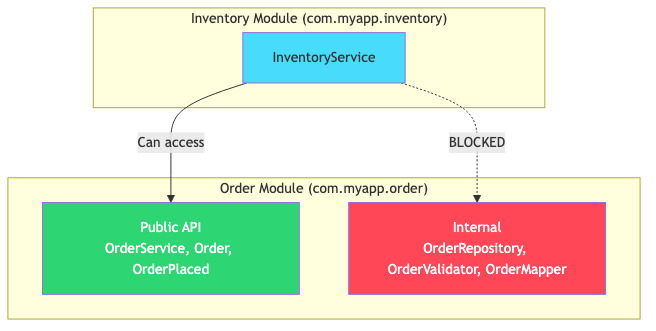
Simple rule to remember: Classes at the top level of a module package = public. Classes inside an internal sub-package = private to that module.
Setting Up Spring Modulith
Dependencies
1
2
3
4
5
6
7
8
9
10
11
12
13
14
15
16
17
18
19
20
21
22
23
24
25
26
27
28
29
30
31
32
33
34
35
36
37
38
39
<dependencyManagement>
    <dependencies>
        <dependency>
            <groupId>org.springframework.modulith</groupId>
            <artifactId>spring-modulith-bom</artifactId>
            <version>1.2.0</version>
            <type>pom</type>
            <scope>import</scope>
        </dependency>
    </dependencies>
</dependencyManagement>

<dependencies>
    <!-- Core module support -->
    <dependency>
        <groupId>org.springframework.modulith</groupId>
        <artifactId>spring-modulith-starter-core</artifactId>
    </dependency>

    <!-- Event publication registry (for reliable events) -->
    <dependency>
        <groupId>org.springframework.modulith</groupId>
        <artifactId>spring-modulith-starter-jpa</artifactId>
    </dependency>

    <!-- Testing support -->
    <dependency>
        <groupId>org.springframework.modulith</groupId>
        <artifactId>spring-modulith-starter-test</artifactId>
        <scope>test</scope>
    </dependency>

    <!-- Documentation generation -->
    <dependency>
        <groupId>org.springframework.modulith</groupId>
        <artifactId>spring-modulith-docs</artifactId>
        <scope>test</scope>
    </dependency>
</dependencies>
Module Public API Design
The Order Module’s Public Contract
Think of the public API as a menu at a restaurant. Other modules can see the menu (public classes), but they can’t walk into the kitchen (internal package).
1
2
3
4
5
6
7
8
9
10
package com.myapp.order;

// This is the public API — other modules can use this
public record OrderPlaced(
    Long orderId,
    Long customerId,
    List<OrderItem> items,
    BigDecimal total,
    LocalDateTime placedAt
) {}
1
2
3
4
5
6
7
8
9
10
11
12
13
14
15
16
17
18
19
20
21
22
23
24
25
26
27
28
29
30
31
32
33
34
package com.myapp.order;

@Service
public class OrderService {

    private final OrderRepository orderRepository;
    private final ApplicationEventPublisher events;

    OrderService(OrderRepository orderRepository, ApplicationEventPublisher events) {
        this.orderRepository = orderRepository;
        this.events = events;
    }

    @Transactional
    public Order placeOrder(CreateOrderCommand command) {
        Order order = Order.create(command);
        orderRepository.save(order);

        // Publish event — other modules react without direct coupling
        events.publishEvent(new OrderPlaced(
            order.getId(),
            order.getCustomerId(),
            order.getItems(),
            order.getTotal(),
            LocalDateTime.now()
        ));

        return order;
    }

    public Optional<Order> findById(Long id) {
        return orderRepository.findById(id);
    }
}
Internal Implementation (Hidden from Other Modules)
1
2
3
4
5
6
7
8
package com.myapp.order.internal;

// This class is ONLY accessible within the order module
// Other modules cannot import it — Spring Modulith enforces this
@Repository
interface OrderRepository extends JpaRepository<Order, Long> {
    List<Order> findByCustomerIdOrderByCreatedAtDesc(Long customerId);
}
1
2
3
4
5
6
7
8
9
10
11
package com.myapp.order.internal;

@Component
class OrderValidator {

    boolean isValid(CreateOrderCommand command) {
        return command.items() != null
            && !command.items().isEmpty()
            && command.items().stream().allMatch(i -> i.quantity() > 0);
    }
}
Event-Driven Communication Between Modules
This is probably the most important concept to understand. Instead of module A directly calling module B (tight coupling), modules communicate by broadcasting events — like a radio station.
The Difference Visualized
Without events (tight coupling):
graph LR
    A[OrderService] -->|"calls directly"| B[InventoryService]
    A -->|"calls directly"| C[NotificationService]
    A -->|"calls directly"| D[AnalyticsService]
    A -->|"calls directly"| E[LoyaltyService]

    style A fill:#ff6b6b,color:#fff
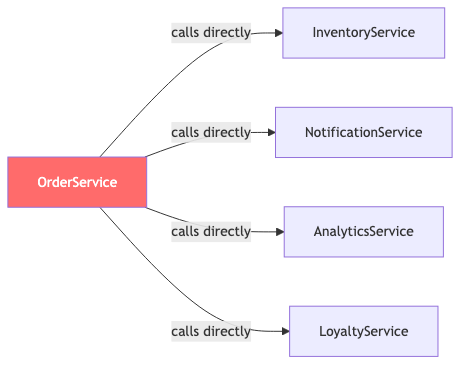
The OrderService needs to know about EVERY service that cares about orders. Adding a new one means editing OrderService.
With events (loose coupling):
graph TD
    A[OrderService] -->|"publishes"| EVT((OrderPlaced Event))
    EVT -->|"listens"| B[InventoryService]
    EVT -->|"listens"| C[NotificationService]
    EVT -->|"listens"| D[AnalyticsService]
    EVT -->|"listens"| E[LoyaltyService]

    style A fill:#2ed573,color:#fff
    style EVT fill:#feca57,color:#333
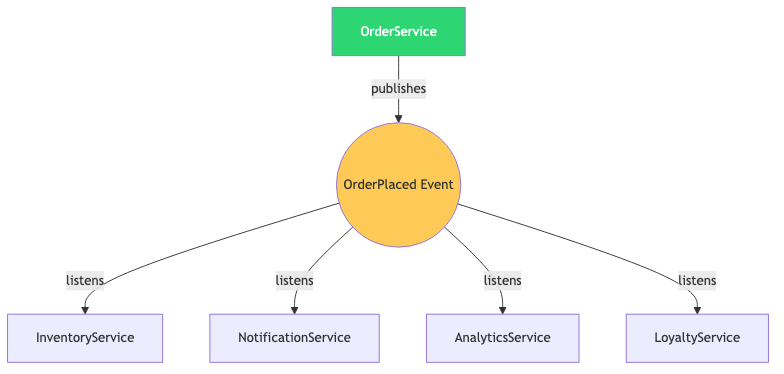
OrderService just says “hey, an order was placed” and doesn’t care who’s listening. Want to add analytics? Just add a listener. Zero changes to the order module.
Publisher (Order Module)
1
2
3
4
5
package com.myapp.order;

// Event records — part of the order module's public API
public record OrderPlaced(Long orderId, Long customerId, BigDecimal total, LocalDateTime placedAt) {}
public record OrderCancelled(Long orderId, String reason, LocalDateTime cancelledAt) {}
Listener (Inventory Module)
1
2
3
4
5
6
7
8
9
10
11
12
13
14
15
16
17
18
19
20
21
package com.myapp.inventory;

@Service
public class InventoryService {

    private final InventoryRepository inventoryRepository;

    @ApplicationModuleListener  // Spring Modulith annotation for module event handling
    void on(OrderPlaced event) {
        // Reserve stock for the order
        event.items().forEach(item ->
            inventoryRepository.decrementStock(item.productId(), item.quantity())
        );
    }

    @ApplicationModuleListener
    void on(OrderCancelled event) {
        // Release reserved stock
        inventoryRepository.releaseReservation(event.orderId());
    }
}
Listener (Notification Module)
1
2
3
4
5
6
7
8
9
10
11
12
13
14
package com.myapp.notification;

@Service
public class NotificationService {

    @ApplicationModuleListener
    void on(OrderPlaced event) {
        // Send order confirmation email
        sendEmail(event.customerId(), "order-confirmation", Map.of(
            "orderId", event.orderId(),
            "total", event.total()
        ));
    }
}
Why Events Over Direct Calls?
| Direct Call | Event-Driven |
|---|---|
| Order module must know about Inventory, Notification, Analytics… | Order module just publishes “OrderPlaced” |
| Adding a new listener means modifying the order module | New module listens without touching existing code |
| Tight coupling — hard to test in isolation | Loose coupling — each module testable independently |
| Failure in notification breaks order placement | Failure in notification doesn’t affect orders |
Reliable Event Publication
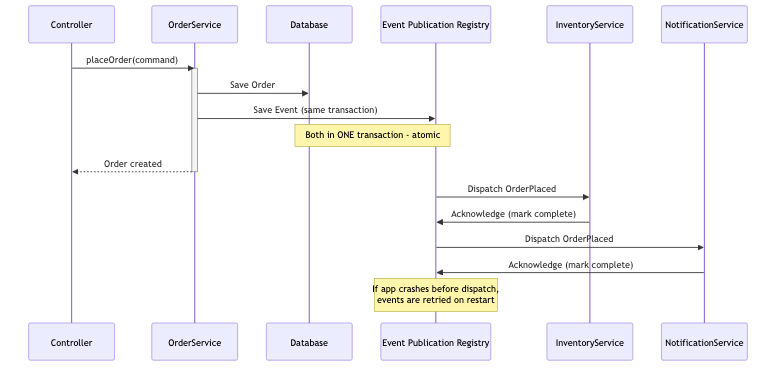
Here’s a real concern: what if the app crashes after saving the order but before the event reaches the notification module? The customer paid but never got a confirmation email.
Spring Modulith solves this with an Event Publication Registry — it stores events in the same database transaction as your business data.
sequenceDiagram
    participant C as Controller
    participant OS as OrderService
    participant DB as Database
    participant EPR as Event Publication Registry
    participant IS as InventoryService
    participant NS as NotificationService

    C->>OS: placeOrder(command)
    activate OS
    OS->>DB: Save Order
    OS->>EPR: Save Event (same transaction)
    Note over DB,EPR: Both in ONE transaction - atomic
    OS-->>C: Order created
    deactivate OS

    EPR->>IS: Dispatch OrderPlaced
    IS->>EPR: Acknowledge (mark complete)
    EPR->>NS: Dispatch OrderPlaced
    NS->>EPR: Acknowledge (mark complete)

    Note over EPR: If app crashes before dispatch,<br/>events are retried on restart
Configuration
1
2
3
4
5
6
7
8
# application.yml
spring:
  modulith:
    republish-outstanding-events-on-restart: true
    events:
      publication-registry:
        completion:
          max-age: 7d
Why this matters: Without this, you’d have the classic “I saved the data but the side-effect didn’t happen” bug. The registry guarantees that events will eventually be delivered, even if the app crashes right after the transaction commits.
Enforcing Module Boundaries
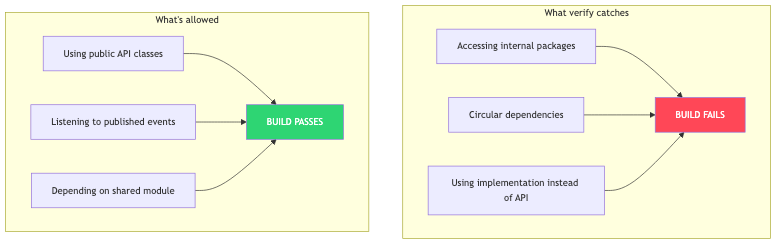
This is where Spring Modulith really shines for teams. It’s not just guidelines in a wiki that nobody reads — it’s a test that fails your build if someone breaks the rules.
Architecture Verification Test
1
2
3
4
5
6
7
8
class ModularityTests {

    @Test
    void verifyModuleStructure() {
        ApplicationModules modules = ApplicationModules.of(MyApplication.class);
        modules.verify();
    }
}
If a developer in the payment module tries to use OrderRepository (which is internal to the order module):
1
2
Module 'payment' depends on non-exposed type
com.myapp.order.internal.OrderRepository in module 'order'
Build fails. The developer learns they need to use the public API (OrderService) instead.
What Gets Caught
graph TD
    subgraph "What verify catches"
        A["Accessing internal packages"] --> FAIL[BUILD FAILS]
        B["Circular dependencies"] --> FAIL
        C["Using implementation instead of API"] --> FAIL
    end

    subgraph "What's allowed"
        D["Using public API classes"] --> PASS[BUILD PASSES]
        E["Listening to published events"] --> PASS
        F["Depending on shared module"] --> PASS
    end

    style FAIL fill:#ff4757,color:#fff
    style PASS fill:#2ed573,color:#fff
Testing Modules in Isolation
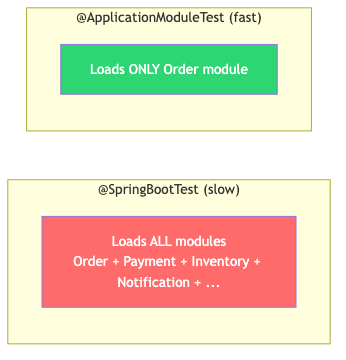
As a junior developer, you might have experienced tests that take 2 minutes to start because they load the entire application. With @ApplicationModuleTest, you only load the module you’re testing:
graph LR
    subgraph "@SpringBootTest (slow)"
        ALL[Loads ALL modules<br/>Order + Payment + Inventory + Notification + ...]
    end

    subgraph "@ApplicationModuleTest (fast)"
        ONE[Loads ONLY Order module]
    end

    style ALL fill:#ff6b6b,color:#fff
    style ONE fill:#2ed573,color:#fff
Bootstrap Only One Module
1
2
3
4
5
6
7
8
9
10
11
12
13
14
15
16
17
18
19
20
21
22
@ApplicationModuleTest
class OrderModuleTest {

    @Autowired
    private OrderService orderService;

    @Test
    void placeOrder_shouldPublishEvent(Scenario scenario) {
        var command = new CreateOrderCommand(
            1L,
            List.of(new OrderItem(100L, 2, BigDecimal.valueOf(29.99))),
            "CREDIT_CARD"
        );

        scenario.stimulate(() -> orderService.placeOrder(command))
                .andWaitForEventOfType(OrderPlaced.class)
                .toArriveAndVerify(event -> {
                    assertThat(event.orderId()).isNotNull();
                    assertThat(event.total()).isEqualByComparingTo("59.98");
                });
    }
}
This gives you:
- Fast tests — no loading the whole Spring context
- True isolation — proves the module works independently
- Event verification — confirms the right events get published
Generating Module Documentation
Spring Modulith can auto-generate architecture diagrams from your actual code (not stale wiki pages that nobody updates):
1
2
3
4
5
6
7
8
9
@Test
void generateDocumentation() {
    ApplicationModules modules = ApplicationModules.of(MyApplication.class);

    new Documenter(modules)
        .writeModulesAsPlantUml()
        .writeIndividualModulesAsPlantUml()
        .writeModuleCanvases();
}
This produces diagrams that always reflect reality. The documentation is generated from the code, so it can never go stale.
Explicit Module Configuration (Advanced)
For cases where the package convention isn’t enough:
1
2
3
4
5
6
7
package com.myapp.order;

@ApplicationModule(
    allowedDependencies = {"inventory", "shared"},
    displayName = "Order Management"
)
class package-info {}
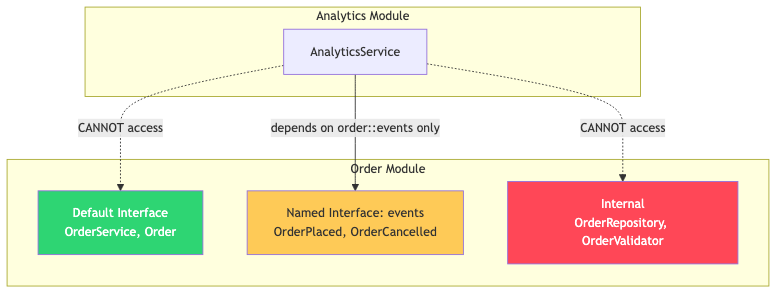
Named Interfaces (Exposing Specific Sub-packages)
Sometimes a module wants to expose only its events, not its full service API:
graph TD
    subgraph "Order Module"
        API["Default Interface<br/>OrderService, Order"]
        EVT["Named Interface: events<br/>OrderPlaced, OrderCancelled"]
        INT["Internal<br/>OrderRepository, OrderValidator"]
    end

    subgraph "Analytics Module"
        AN[AnalyticsService]
    end

    AN -->|"depends on order::events only"| EVT
    AN -.->|"CANNOT access"| API
    AN -.->|"CANNOT access"| INT

    style EVT fill:#feca57,color:#333
    style API fill:#2ed573,color:#fff
    style INT fill:#ff4757,color:#fff
1
@ApplicationModule(allowedDependencies = "order::events")  // Only use the events API
From Modular Monolith to Microservice
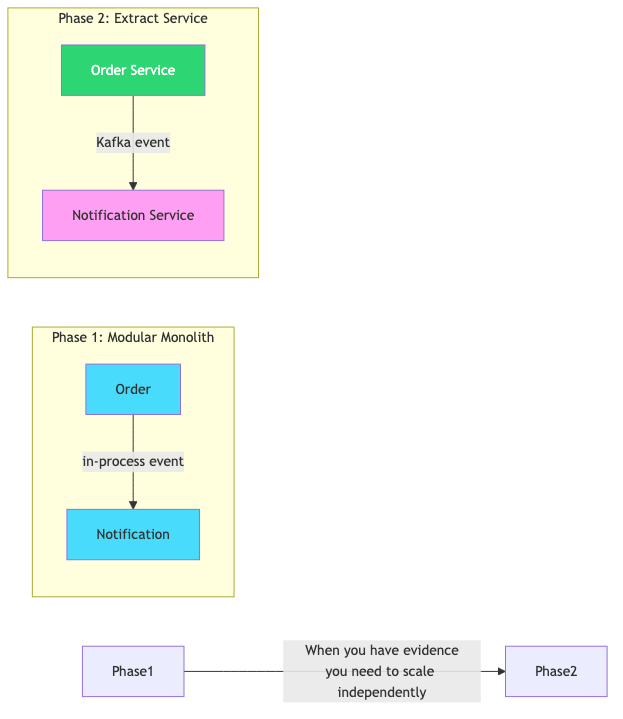
This is the endgame benefit. When (if!) you actually need to extract a module into its own service, the path is clean because boundaries were enforced from day one:
graph LR
    subgraph "Phase 1: Modular Monolith"
        direction TB
        A1[Order] -->|"in-process event"| B1[Notification]
    end

    subgraph "Phase 2: Extract Service"
        direction TB
        A2[Order Service] -->|"Kafka event"| B2[Notification Service]
    end

    Phase1 -->|"When you have evidence<br/>you need to scale independently"| Phase2

    style A1 fill:#48dbfb,color:#333
    style B1 fill:#48dbfb,color:#333
    style A2 fill:#2ed573,color:#fff
    style B2 fill:#ff9ff3,color:#333
Step 1: Module Already Has Clean Boundaries
1
2
3
4
5
6
com.myapp.notification/
├── NotificationService.java       ← Public API
├── OrderPlaced handler            ← Reacts to events
└── internal/
    ├── EmailSender.java
    └── TemplateEngine.java
Step 2: Replace In-Process Events with External Events
1
2
3
4
5
6
7
// Before: Spring ApplicationEvent (in-process)
@ApplicationModuleListener
void on(OrderPlaced event) { ... }

// After: Kafka/RabbitMQ listener (cross-service)
@KafkaListener(topics = "order-events")
void on(OrderPlaced event) { ... }
Step 3: Deploy Independently
The module becomes its own Spring Boot application. Because the boundaries were enforced all along, the extraction is mechanical — no untangling of dependencies needed.
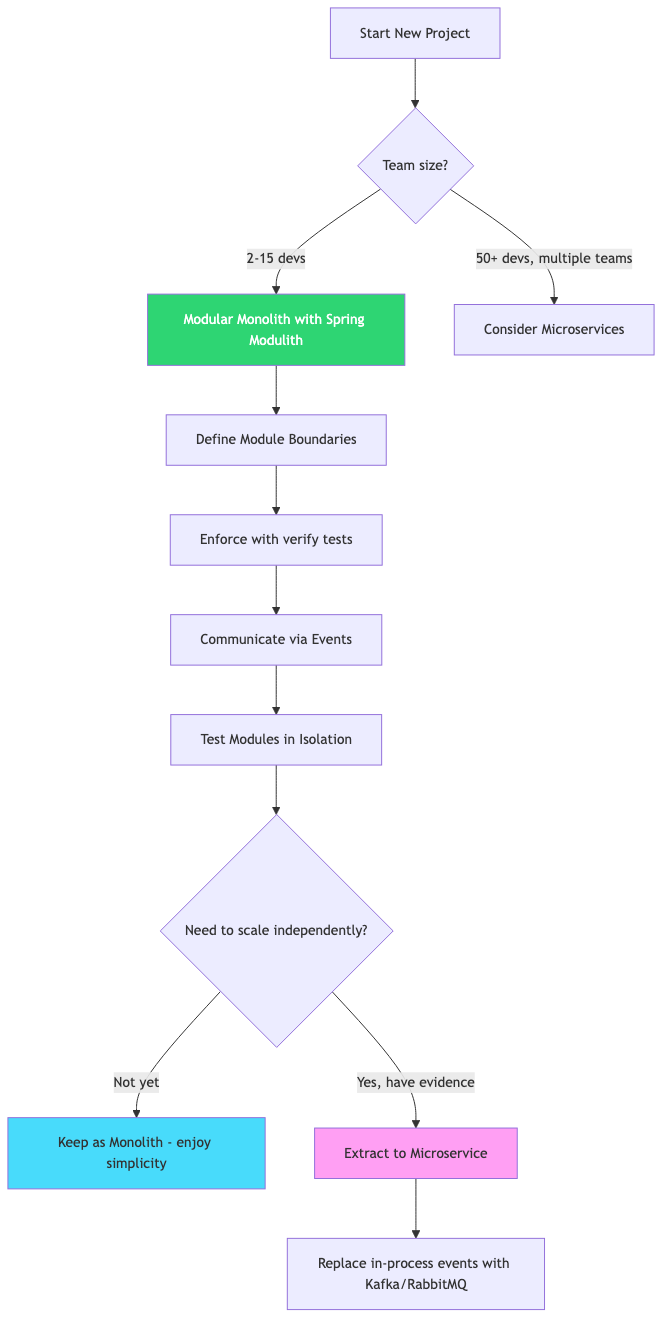
The Full Lifecycle — How It All Fits Together
flowchart TD
    A[Start New Project] --> B{Team size?}
    B -->|"2-15 devs"| C[Modular Monolith with Spring Modulith]
    B -->|"50+ devs, multiple teams"| D[Consider Microservices]

    C --> E[Define Module Boundaries]
    E --> F[Enforce with verify tests]
    F --> G[Communicate via Events]
    G --> H[Test Modules in Isolation]
    H --> I{Need to scale independently?}
    I -->|"Not yet"| J[Keep as Monolith - enjoy simplicity]
    I -->|"Yes, have evidence"| K[Extract to Microservice]
    K --> L[Replace in-process events with Kafka/RabbitMQ]

    style C fill:#2ed573,color:#fff
    style J fill:#48dbfb,color:#333
    style K fill:#ff9ff3,color:#333
When to Choose a Modular Monolith
Choose modular monolith when:
- You’re in the early stages of a product and boundaries aren’t clear yet
- Your team is small to medium (2-15 developers)
- You value simplicity — one deploy, one database, no network failures between modules
- You want the option to extract services later without upfront distributed systems tax
- Your modules share transactional boundaries (orders + inventory in one ACID transaction)
Choose microservices when:
- Multiple independent teams need to deploy at different cadences
- Modules have genuinely different scaling requirements (100x traffic on search vs. 1x on billing)
- You need polyglot — some modules require different languages/runtimes
- Your organization is large enough to afford the operational overhead
Quick Reference
| Feature | What It Does |
|---|---|
| Package convention | Top-level packages = modules, internal = encapsulated |
ApplicationModules.verify() | Fails if modules violate boundaries |
@ApplicationModuleListener | Handles events from other modules |
| Event Publication Registry | Persists events for reliable delivery |
@ApplicationModuleTest | Tests a single module in isolation |
| Named interfaces | Fine-grained control over what’s exposed |
Documenter | Auto-generates architecture diagrams |
Start with a modular monolith. Extract to microservices when you have evidence you need to — not when you think you might. As a junior developer, this is the most important architecture lesson: complexity must be earned, not assumed.