Spring Boot Error Handling — A Complete Guide (REST, Async, WebSocket)
The definitive guide to error handling in Spring Boot. Covers @ControllerAdvice, ProblemDetail (RFC 7807), custom exception hierarchies, validation errors, async error handling, WebSocket errors, and a production-ready error response strategy.
The Problem: Inconsistent Error Responses
Without proper error handling, your API returns different error formats depending on where the error occurs:
1
2
3
4
5
6
7
8
9
10
11
// Spring default (missing endpoint)
{ "timestamp": "...", "status": 404, "error": "Not Found", "path": "/api/users/999" }

// Your manual response
{ "code": "USER_NOT_FOUND", "message": "User 999 does not exist" }

// Validation error (default)
{ "timestamp": "...", "status": 400, "errors": [...] }

// Unhandled exception
{ "timestamp": "...", "status": 500, "error": "Internal Server Error" }
Your API consumers deal with four different formats. Every client needs special-case parsing.
The fix: a single, consistent error response contract for every error condition.
The Error Response Contract: RFC 7807 ProblemDetail
Spring Boot 3.x natively supports RFC 7807 (Problem Details for HTTP APIs):
1
2
3
4
5
6
7
8
9
{
  "type": "https://api.example.com/errors/user-not-found",
  "title": "User Not Found",
  "status": 404,
  "detail": "User with ID 999 does not exist",
  "instance": "/api/users/999",
  "errorCode": "USER_NOT_FOUND",
  "traceId": "6a2b3c4d5e6f7890"
}
| Field | Purpose |
|---|---|
type | URI reference identifying the error type (documentation link) |
title | Human-readable summary |
status | HTTP status code |
detail | Human-readable explanation specific to this occurrence |
instance | URI of the specific request that failed |
| Custom fields | Any additional context (errorCode, traceId, fieldErrors) |
Enable in Spring Boot 3.x:
1
2
3
4
spring:
  mvc:
    problemdetails:
      enabled: true
@ControllerAdvice + @ExceptionHandler
The foundation of Spring Boot error handling. A single class catches exceptions from all controllers:
1
2
3
4
5
6
7
8
9
10
11
12
13
14
15
16
17
18
19
20
21
22
23
24
25
26
27
28
29
30
31
32
33
34
35
36
37
38
39
40
41
42
43
44
45
46
47
48
49
50
51
52
53
54
55
56
@RestControllerAdvice
public class GlobalExceptionHandler {

    @ExceptionHandler(ResourceNotFoundException.class)
    public ProblemDetail handleNotFound(ResourceNotFoundException ex,
                                        HttpServletRequest request) {
        ProblemDetail problem = ProblemDetail.forStatusAndDetail(
                HttpStatus.NOT_FOUND, ex.getMessage());
        problem.setTitle("Resource Not Found");
        problem.setType(URI.create("https://api.example.com/errors/not-found"));
        problem.setInstance(URI.create(request.getRequestURI()));
        problem.setProperty("errorCode", ex.getErrorCode());
        problem.setProperty("traceId", MDC.get("traceId"));
        return problem;
    }

    @ExceptionHandler(BusinessValidationException.class)
    public ProblemDetail handleBusinessValidation(BusinessValidationException ex,
                                                   HttpServletRequest request) {
        ProblemDetail problem = ProblemDetail.forStatusAndDetail(
                HttpStatus.UNPROCESSABLE_ENTITY, ex.getMessage());
        problem.setTitle("Business Rule Violation");
        problem.setType(URI.create("https://api.example.com/errors/validation"));
        problem.setInstance(URI.create(request.getRequestURI()));
        problem.setProperty("errorCode", ex.getErrorCode());
        problem.setProperty("traceId", MDC.get("traceId"));
        return problem;
    }

    @ExceptionHandler(ConflictException.class)
    public ProblemDetail handleConflict(ConflictException ex,
                                        HttpServletRequest request) {
        ProblemDetail problem = ProblemDetail.forStatusAndDetail(
                HttpStatus.CONFLICT, ex.getMessage());
        problem.setTitle("Resource Conflict");
        problem.setType(URI.create("https://api.example.com/errors/conflict"));
        problem.setInstance(URI.create(request.getRequestURI()));
        problem.setProperty("errorCode", ex.getErrorCode());
        return problem;
    }

    @ExceptionHandler(Exception.class)
    public ProblemDetail handleUnexpected(Exception ex, HttpServletRequest request) {
        // Log the full stack trace — never expose it to the client
        log.error("Unexpected error on {}", request.getRequestURI(), ex);

        ProblemDetail problem = ProblemDetail.forStatusAndDetail(
                HttpStatus.INTERNAL_SERVER_ERROR,
                "An unexpected error occurred. Please try again later.");
        problem.setTitle("Internal Server Error");
        problem.setType(URI.create("https://api.example.com/errors/internal"));
        problem.setInstance(URI.create(request.getRequestURI()));
        problem.setProperty("traceId", MDC.get("traceId"));
        return problem;
    }
}
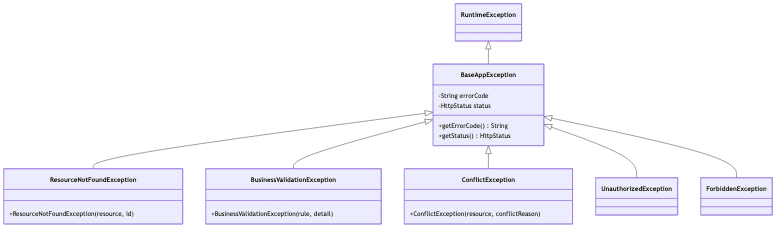
Custom Exception Hierarchy
A well-designed exception hierarchy maps cleanly to HTTP status codes:
classDiagram
    RuntimeException <|-- BaseAppException
    BaseAppException <|-- ResourceNotFoundException
    BaseAppException <|-- BusinessValidationException
    BaseAppException <|-- ConflictException
    BaseAppException <|-- UnauthorizedException
    BaseAppException <|-- ForbiddenException

    class BaseAppException {
        -String errorCode
        -HttpStatus status
        +getErrorCode() String
        +getStatus() HttpStatus
    }
    class ResourceNotFoundException {
        +ResourceNotFoundException(resource, id)
    }
    class BusinessValidationException {
        +BusinessValidationException(rule, detail)
    }
    class ConflictException {
        +ConflictException(resource, conflictReason)
    }
Base Exception
1
2
3
4
5
6
7
8
9
10
11
12
13
14
public abstract class BaseAppException extends RuntimeException {

    private final String errorCode;
    private final HttpStatus status;

    protected BaseAppException(String message, String errorCode, HttpStatus status) {
        super(message);
        this.errorCode = errorCode;
        this.status = status;
    }

    public String getErrorCode() { return errorCode; }
    public HttpStatus getStatus() { return status; }
}
Concrete Exceptions
1
2
3
4
5
6
7
8
9
10
11
12
13
14
15
16
17
18
19
20
21
22
23
24
25
26
27
28
public class ResourceNotFoundException extends BaseAppException {

    public ResourceNotFoundException(String resource, Object id) {
        super(
            String.format("%s with ID %s not found", resource, id),
            "RESOURCE_NOT_FOUND",
            HttpStatus.NOT_FOUND
        );
    }
}

public class BusinessValidationException extends BaseAppException {

    public BusinessValidationException(String rule, String detail) {
        super(detail, rule, HttpStatus.UNPROCESSABLE_ENTITY);
    }
}

public class ConflictException extends BaseAppException {

    public ConflictException(String resource, String reason) {
        super(
            String.format("%s conflict: %s", resource, reason),
            "RESOURCE_CONFLICT",
            HttpStatus.CONFLICT
        );
    }
}
Usage in Service Layer
1
2
3
4
5
6
7
8
9
10
11
12
13
14
15
16
17
18
19
20
@Service
public class UserService {

    public User getById(Long id) {
        return userRepository.findById(id)
                .orElseThrow(() -> new ResourceNotFoundException("User", id));
    }

    public User register(UserRegistration request) {
        if (userRepository.existsByEmail(request.email())) {
            throw new ConflictException("User", "Email already registered");
        }
        if (request.age() < 18) {
            throw new BusinessValidationException(
                    "MIN_AGE_REQUIREMENT",
                    "User must be at least 18 years old");
        }
        return userRepository.save(mapToEntity(request));
    }
}
Validation Errors: @Valid and MethodArgumentNotValidException
Jakarta Bean Validation errors need special handling to return per-field errors:
1
2
3
4
5
6
7
8
9
10
11
12
13
14
15
16
17
18
19
20
21
22
@ExceptionHandler(MethodArgumentNotValidException.class)
public ProblemDetail handleValidation(MethodArgumentNotValidException ex,
                                       HttpServletRequest request) {
    ProblemDetail problem = ProblemDetail.forStatusAndDetail(
            HttpStatus.BAD_REQUEST, "Request validation failed");
    problem.setTitle("Validation Error");
    problem.setType(URI.create("https://api.example.com/errors/validation"));
    problem.setInstance(URI.create(request.getRequestURI()));

    List<Map<String, String>> fieldErrors = ex.getBindingResult()
            .getFieldErrors().stream()
            .map(error -> Map.of(
                    "field", error.getField(),
                    "message", error.getDefaultMessage(),
                    "rejectedValue", String.valueOf(error.getRejectedValue())
            ))
            .toList();

    problem.setProperty("fieldErrors", fieldErrors);
    problem.setProperty("errorCode", "VALIDATION_FAILED");
    return problem;
}
Response:
1
2
3
4
5
6
7
8
9
10
11
{
  "type": "https://api.example.com/errors/validation",
  "title": "Validation Error",
  "status": 400,
  "detail": "Request validation failed",
  "fieldErrors": [
    { "field": "email", "message": "must be a valid email", "rejectedValue": "not-an-email" },
    { "field": "name", "message": "must not be blank", "rejectedValue": "" }
  ],
  "errorCode": "VALIDATION_FAILED"
}
ProblemDetail: Spring Boot 3.x Native Support
Spring Boot 3.x has built-in RFC 7807 support. Enable it and Spring auto-converts many exceptions:
1
2
3
4
spring:
  mvc:
    problemdetails:
      enabled: true
Built-in mappings:
| Exception | Status | ProblemDetail title |
|---|---|---|
HttpRequestMethodNotSupportedException | 405 | Method Not Allowed |
HttpMediaTypeNotAcceptableException | 406 | Not Acceptable |
MissingServletRequestParameterException | 400 | Bad Request |
TypeMismatchException | 400 | Bad Request |
NoHandlerFoundException | 404 | Not Found |
Your @ControllerAdvice extends this with application-specific exceptions.
Async Error Handling
@Async Exceptions
@Async methods run in a separate thread. Exceptions don’t propagate to the caller:
1
2
3
4
5
6
7
8
9
10
11
12
@Configuration
@EnableAsync
public class AsyncConfig implements AsyncConfigurer {

    @Override
    public AsyncUncaughtExceptionHandler getAsyncUncaughtExceptionHandler() {
        return (throwable, method, params) -> {
            log.error("Async error in method {}: {}", method.getName(), throwable.getMessage(), throwable);
            // Alert monitoring, send to dead-letter queue, etc.
        };
    }
}
CompletableFuture Error Handling
For async methods that return CompletableFuture:
1
2
3
4
5
6
7
8
9
10
@Async
public CompletableFuture<PaymentResult> processPayment(PaymentRequest request) {
    return CompletableFuture.supplyAsync(() -> {
        // processing logic
        return paymentGateway.charge(request);
    }).exceptionally(throwable -> {
        log.error("Payment processing failed for order {}", request.orderId(), throwable);
        return PaymentResult.failed(request.orderId(), throwable.getMessage());
    });
}
In the controller:
1
2
3
4
5
6
7
@PostMapping("/payments")
public CompletableFuture<ResponseEntity<PaymentResult>> pay(@RequestBody PaymentRequest request) {
    return paymentService.processPayment(request)
            .thenApply(result -> result.isSuccess()
                    ? ResponseEntity.ok(result)
                    : ResponseEntity.status(HttpStatus.PAYMENT_REQUIRED).body(result));
}
WebSocket Error Handling
WebSocket errors need @MessageExceptionHandler — @ControllerAdvice doesn’t apply to WebSocket message handling:
1
2
3
4
5
6
7
8
9
10
11
12
13
14
15
16
17
18
19
20
21
22
23
24
25
@Controller
public class ChatController {

    @MessageMapping("/chat")
    @SendTo("/topic/messages")
    public ChatMessage handleMessage(ChatMessage message) {
        if (message.content().isBlank()) {
            throw new IllegalArgumentException("Message content cannot be empty");
        }
        return message;
    }

    @MessageExceptionHandler(IllegalArgumentException.class)
    @SendToUser("/queue/errors")
    public ErrorMessage handleWebSocketError(IllegalArgumentException ex) {
        return new ErrorMessage("VALIDATION_ERROR", ex.getMessage());
    }

    @MessageExceptionHandler(Exception.class)
    @SendToUser("/queue/errors")
    public ErrorMessage handleGenericWebSocketError(Exception ex) {
        log.error("WebSocket error", ex);
        return new ErrorMessage("INTERNAL_ERROR", "An unexpected error occurred");
    }
}
Key differences from REST:
- Use
@MessageExceptionHandlerinstead of@ExceptionHandler - Use
@SendToUser("/queue/errors")to send error back to the specific client - No HTTP status codes — use application-level error codes
Error Response Structure: Before and After
| Scenario | Before (inconsistent) | After (RFC 7807) |
|---|---|---|
| Not Found | { "error": "User not found" } | { "type": ".../not-found", "title": "Resource Not Found", "status": 404, "detail": "User with ID 999 not found" } |
| Validation | { "errors": ["email invalid"] } | { "type": ".../validation", "status": 400, "fieldErrors": [...] } |
| Conflict | HTTP 500 + stack trace | { "type": ".../conflict", "status": 409, "detail": "Email already registered" } |
| Server Error | Stack trace in response | { "type": ".../internal", "status": 500, "detail": "Unexpected error", "traceId": "abc123" } |
Error Codes Strategy
HTTP status codes tell you the category. Application error codes tell you the exact problem:
1
2
3
4
5
6
7
8
9
10
11
12
13
14
15
16
17
18
19
20
21
22
23
24
public enum ErrorCode {
    // Auth
    AUTH_TOKEN_EXPIRED("Token has expired"),
    AUTH_INVALID_CREDENTIALS("Invalid username or password"),

    // User
    USER_NOT_FOUND("User does not exist"),
    USER_EMAIL_TAKEN("Email already registered"),
    USER_UNDERAGE("Must be at least 18 years old"),

    // Payment
    PAYMENT_INSUFFICIENT_FUNDS("Insufficient funds"),
    PAYMENT_GATEWAY_TIMEOUT("Payment gateway not responding"),

    // General
    VALIDATION_FAILED("Request validation failed"),
    RESOURCE_CONFLICT("Resource state conflict"),
    INTERNAL_ERROR("Internal server error");

    private final String defaultMessage;

    ErrorCode(String defaultMessage) { this.defaultMessage = defaultMessage; }
    public String getDefaultMessage() { return defaultMessage; }
}
Clients can switch on error codes for programmatic handling:
1
2
3
if (error.errorCode === 'USER_EMAIL_TAKEN') {
  showError('This email is already registered. Try logging in instead.');
}
Common Mistakes
| Mistake | Problem | Fix |
|---|---|---|
Catching generic Exception in service layer | Hides the actual error type | Let exceptions propagate to @ControllerAdvice |
| Returning stack traces to clients | Security risk (exposes internals) | Log internally, return generic message |
Using @ResponseStatus on exception class | Can’t add context or custom fields | Use @ExceptionHandler with ProblemDetail |
| Different error formats per endpoint | Client parsing nightmare | Centralize in @ControllerAdvice |
| Logging and rethrowing | Double-logged errors | Log at the boundary only |
HTTP 200 with error body | Breaks HTTP semantics | Use proper status codes |
| No traceId in error response | Can’t correlate client report to server logs | Include traceId from MDC |
| Swallowing exceptions silently | Errors disappear | Always log or propagate |
Complete Implementation Pattern
Putting it all together — a production-ready error handling setup:
1
2
3
4
5
6
7
8
9
10
11
12
13
14
15
16
17
18
19
20
21
22
23
24
25
26
27
28
29
30
31
32
33
34
35
36
37
38
39
40
41
42
43
44
45
46
47
48
49
50
51
52
53
54
55
56
57
58
59
60
61
62
63
64
65
66
@RestControllerAdvice
public class GlobalExceptionHandler {

    private static final Logger log = LoggerFactory.getLogger(GlobalExceptionHandler.class);

    // --- Application Exceptions ---

    @ExceptionHandler(BaseAppException.class)
    public ProblemDetail handleAppException(BaseAppException ex, HttpServletRequest request) {
        ProblemDetail problem = ProblemDetail.forStatusAndDetail(ex.getStatus(), ex.getMessage());
        problem.setTitle(ex.getStatus().getReasonPhrase());
        problem.setInstance(URI.create(request.getRequestURI()));
        problem.setProperty("errorCode", ex.getErrorCode());
        problem.setProperty("traceId", MDC.get("traceId"));
        return problem;
    }

    // --- Validation ---

    @ExceptionHandler(MethodArgumentNotValidException.class)
    public ProblemDetail handleValidation(MethodArgumentNotValidException ex,
                                           HttpServletRequest request) {
        ProblemDetail problem = ProblemDetail.forStatusAndDetail(
                HttpStatus.BAD_REQUEST, "Validation failed");
        problem.setTitle("Validation Error");
        problem.setInstance(URI.create(request.getRequestURI()));
        problem.setProperty("errorCode", "VALIDATION_FAILED");
        problem.setProperty("fieldErrors", ex.getBindingResult().getFieldErrors().stream()
                .map(e -> Map.of("field", e.getField(), "message", e.getDefaultMessage()))
                .toList());
        problem.setProperty("traceId", MDC.get("traceId"));
        return problem;
    }

    @ExceptionHandler(ConstraintViolationException.class)
    public ProblemDetail handleConstraintViolation(ConstraintViolationException ex,
                                                    HttpServletRequest request) {
        ProblemDetail problem = ProblemDetail.forStatusAndDetail(
                HttpStatus.BAD_REQUEST, "Constraint violation");
        problem.setTitle("Validation Error");
        problem.setInstance(URI.create(request.getRequestURI()));
        problem.setProperty("errorCode", "CONSTRAINT_VIOLATION");
        problem.setProperty("violations", ex.getConstraintViolations().stream()
                .map(v -> Map.of("path", v.getPropertyPath().toString(),
                                 "message", v.getMessage()))
                .toList());
        return problem;
    }

    // --- Catch-all ---

    @ExceptionHandler(Exception.class)
    public ProblemDetail handleUnexpected(Exception ex, HttpServletRequest request) {
        log.error("Unhandled exception on {} {}", request.getMethod(),
                request.getRequestURI(), ex);

        ProblemDetail problem = ProblemDetail.forStatusAndDetail(
                HttpStatus.INTERNAL_SERVER_ERROR,
                "An unexpected error occurred. Please contact support with the traceId.");
        problem.setTitle("Internal Server Error");
        problem.setInstance(URI.create(request.getRequestURI()));
        problem.setProperty("errorCode", "INTERNAL_ERROR");
        problem.setProperty("traceId", MDC.get("traceId"));
        return problem;
    }
}