Event-Driven Microservices with Spring Boot + Kafka
Build event-driven microservices with Spring Boot and Apache Kafka. Covers producer/consumer patterns, event schemas, error handling with dead letter topics, exactly-once semantics, Testcontainers for Kafka testing, and a complete order processing pipeline.
The Problem
Your Spring Modulith application uses events internally. But when modules become separate services — different deployables, different databases, different teams — you need events that cross process boundaries.
Synchronous REST calls between services create tight coupling, cascading failures, and retry storms. You need an event broker that decouples producers from consumers, buffers during spikes, and guarantees delivery.
Apache Kafka is the industry standard for this. Spring Kafka makes it feel like writing a @Service.
What We Are Building
An order processing pipeline with three services communicating via Kafka events:
flowchart LR
    subgraph "Order Service"
        A[REST API] --> B[OrderCreatedEvent]
    end

    subgraph "Kafka"
        B --> T1[orders topic]
        T1 --> C
        T1 --> D
    end

    subgraph "Payment Service"
        C[Consumer] --> E[Process Payment]
        E --> F[PaymentCompletedEvent]
    end

    subgraph "Notification Service"
        D[Consumer] --> G[Send Email]
    end

    F --> T2[payments topic]

    style T1 fill:#feca57,color:#333
    style T2 fill:#48dbfb,color:#333

Key patterns demonstrated:
- Event publishing (producer)
- Event consumption (consumer groups)
- Dead Letter Topic (DLT) for failed messages
- Retry and error handling
- Integration testing with Testcontainers
Prerequisites
| Component | Version |
|---|---|
| Java | 21+ |
| Spring Boot | 3.5+ |
| Docker | Latest (for Kafka) |
| Maven | 3.9+ |
Project Structure
1
2
3
4
5
6
7
spring-boot-kafka-microservices/
├── pom.xml (parent)
├── docker-compose.yml
├── shared-events/          # Event schemas (shared library)
├── order-service/          # Produces OrderCreatedEvent
├── payment-service/        # Consumes orders, produces PaymentCompletedEvent
└── notification-service/   # Consumes both events, sends notifications
Step 1: Infrastructure (docker-compose.yml)
1
2
3
4
5
6
7
8
9
10
11
12
13
14
15
16
services:
  kafka:
    image: confluentinc/cp-kafka:7.6.0
    container_name: kafka
    ports:
      - "9092:9092"
    environment:
      KAFKA_NODE_ID: 1
      KAFKA_LISTENER_SECURITY_PROTOCOL_MAP: CONTROLLER:PLAINTEXT,PLAINTEXT:PLAINTEXT
      KAFKA_ADVERTISED_LISTENERS: PLAINTEXT://localhost:9092
      KAFKA_PROCESS_ROLES: broker,controller
      KAFKA_CONTROLLER_QUORUM_VOTERS: 1@kafka:29093
      KAFKA_CONTROLLER_LISTENER_NAMES: CONTROLLER
      KAFKA_LISTENERS: PLAINTEXT://0.0.0.0:9092,CONTROLLER://0.0.0.0:29093
      CLUSTER_ID: "MkU3OEVBNTcwNTJENDM2Qk"
      KAFKA_OFFSETS_TOPIC_REPLICATION_FACTOR: 1
1
docker compose up -d
KRaft mode (no ZooKeeper). Single broker for development.
Step 2: Shared Event Schemas
1
2
3
4
5
6
7
8
9
10
11
12
13
14
15
16
17
18
19
20
21
22
23
// shared-events module
public record OrderCreatedEvent(
        String orderId,
        String customerId,
        BigDecimal totalAmount,
        List<OrderItem> items,
        Instant createdAt
) {}

public record PaymentCompletedEvent(
        String paymentId,
        String orderId,
        String status,
        BigDecimal amount,
        Instant processedAt
) {}

public record OrderItem(
        String productId,
        String name,
        int quantity,
        BigDecimal price
) {}
Shared events as records — immutable, serializable, versioned as a library.
Step 3: Order Service (Producer)
Configuration
1
2
3
4
5
6
7
8
9
spring:
  kafka:
    bootstrap-servers: localhost:9092
    producer:
      key-serializer: org.apache.kafka.common.serialization.StringSerializer
      value-serializer: org.springframework.kafka.support.serializer.JsonSerializer
      properties:
        spring.json.type.mapping: >
          orderCreated:com.anupam.events.OrderCreatedEvent
Publishing Events
1
2
3
4
5
6
7
8
9
10
11
12
13
14
15
16
17
18
19
20
21
22
23
24
25
26
27
28
29
30
31
32
33
34
35
36
@Service
public class OrderService {

    private final KafkaTemplate<String, OrderCreatedEvent> kafkaTemplate;

    public OrderService(KafkaTemplate<String, OrderCreatedEvent> kafkaTemplate) {
        this.kafkaTemplate = kafkaTemplate;
    }

    public Order createOrder(CreateOrderRequest request) {
        Order order = new Order(UUID.randomUUID().toString(), request.customerId(),
                request.items(), OrderStatus.CREATED);

        // Publish event — Kafka handles delivery
        OrderCreatedEvent event = new OrderCreatedEvent(
                order.orderId(),
                order.customerId(),
                order.totalAmount(),
                order.items(),
                Instant.now()
        );

        kafkaTemplate.send("orders", order.orderId(), event)
                .whenComplete((result, ex) -> {
                    if (ex != null) {
                        log.error("Failed to publish OrderCreatedEvent: {}", order.orderId(), ex);
                    } else {
                        log.info("Published OrderCreatedEvent to partition {} offset {}",
                                result.getRecordMetadata().partition(),
                                result.getRecordMetadata().offset());
                    }
                });

        return order;
    }
}
Key design: the event is published after the order is created in-memory. In production, use the Outbox Pattern (save event to DB in same transaction, publish asynchronously) for guaranteed delivery.
Step 4: Payment Service (Consumer)
Configuration
1
2
3
4
5
6
7
8
9
10
spring:
  kafka:
    bootstrap-servers: localhost:9092
    consumer:
      group-id: payment-service
      auto-offset-reset: earliest
      key-deserializer: org.apache.kafka.common.serialization.StringDeserializer
      value-deserializer: org.springframework.kafka.support.serializer.JsonDeserializer
      properties:
        spring.json.trusted.packages: "com.anupam.events"
Consuming Events
1
2
3
4
5
6
7
8
9
10
11
12
13
14
15
16
17
18
19
20
21
22
23
24
25
@Service
public class PaymentProcessor {

    private final KafkaTemplate<String, PaymentCompletedEvent> kafkaTemplate;

    @KafkaListener(topics = "orders", groupId = "payment-service")
    public void handleOrderCreated(OrderCreatedEvent event) {
        log.info("Processing payment for order: {}", event.orderId());

        // Simulate payment processing
        PaymentResult result = processPayment(event);

        // Publish downstream event
        PaymentCompletedEvent paymentEvent = new PaymentCompletedEvent(
                UUID.randomUUID().toString(),
                event.orderId(),
                result.status(),
                event.totalAmount(),
                Instant.now()
        );

        kafkaTemplate.send("payments", event.orderId(), paymentEvent);
        log.info("Payment {} for order {}", result.status(), event.orderId());
    }
}
Step 5: Error Handling with Dead Letter Topic
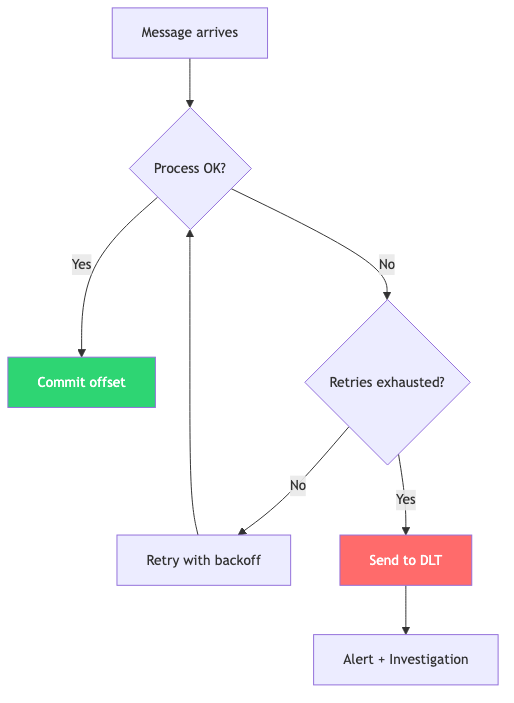
Failed messages shouldn’t block the queue. Route them to a DLT:
1
2
3
4
5
6
7
8
9
10
11
12
13
14
15
16
17
18
19
20
21
22
@Configuration
public class KafkaConfig {

    @Bean
    public DefaultErrorHandler errorHandler(KafkaTemplate<String, Object> template) {
        // Retry 3 times with backoff, then send to DLT
        DeadLetterPublishingRecoverer recoverer =
                new DeadLetterPublishingRecoverer(template);

        BackOff backOff = new FixedBackOff(1000L, 3); // 1s interval, 3 retries

        DefaultErrorHandler handler = new DefaultErrorHandler(recoverer, backOff);

        // Don't retry these — they'll never succeed
        handler.addNotRetryableExceptions(
                JsonParseException.class,
                DeserializationException.class
        );

        return handler;
    }
}
1
2
3
4
5
6
7
8
// Monitor the DLT for failed messages
@KafkaListener(topics = "orders.DLT", groupId = "dlt-processor")
public void handleDeadLetter(ConsumerRecord<String, byte[]> record) {
    log.error("Dead letter received — topic: {}, key: {}, reason: {}",
            record.topic(), record.key(),
            new String(record.headers().lastHeader("kafka_dlt-exception-message").value()));
    // Alert, store for investigation, or attempt manual reprocessing
}
flowchart TD
    A[Message arrives] --> B{Process OK?}
    B -->|Yes| C[Commit offset]
    B -->|No| D{Retries exhausted?}
    D -->|No| E[Retry with backoff]
    E --> B
    D -->|Yes| F[Send to DLT]
    F --> G[Alert + Investigation]

    style F fill:#ff6b6b,color:#fff
    style C fill:#2ed573,color:#fff
Step 6: Notification Service (Multi-Topic Consumer)
1
2
3
4
5
6
7
8
9
10
11
12
13
14
15
16
17
@Service
public class NotificationService {

    @KafkaListener(topics = "orders", groupId = "notification-service")
    public void onOrderCreated(OrderCreatedEvent event) {
        sendEmail(event.customerId(),
                "Order Confirmed",
                "Your order " + event.orderId() + " has been placed.");
    }

    @KafkaListener(topics = "payments", groupId = "notification-service")
    public void onPaymentCompleted(PaymentCompletedEvent event) {
        sendEmail(getCustomerForOrder(event.orderId()),
                "Payment Processed",
                "Payment of " + event.amount() + " for order " + event.orderId() + " is " + event.status());
    }
}
Notice: the notification service has its own groupId. It processes the same orders topic independently from the payment service — Kafka delivers to both.
Step 7: Integration Testing with Testcontainers
1
2
3
4
5
6
7
8
9
10
11
12
13
14
15
16
17
18
19
20
21
22
23
24
25
26
27
28
29
30
31
@SpringBootTest
@Testcontainers
class OrderEventFlowTest {

    @Container
    @ServiceConnection
    static KafkaContainer kafka = new KafkaContainer(
            DockerImageName.parse("confluentinc/cp-kafka:7.6.0"));

    @Autowired
    private KafkaTemplate<String, OrderCreatedEvent> kafkaTemplate;

    @Autowired
    private PaymentProcessor paymentProcessor;

    @Test
    void shouldProcessOrderAndPublishPaymentEvent() throws Exception {
        OrderCreatedEvent order = new OrderCreatedEvent(
                "ORD-001", "CUST-42", new BigDecimal("99.99"),
                List.of(new OrderItem("P1", "Widget", 1, new BigDecimal("99.99"))),
                Instant.now());

        kafkaTemplate.send("orders", order.orderId(), order).get();

        Awaitility.await()
                .atMost(Duration.ofSeconds(15))
                .untilAsserted(() ->
                        assertThat(paymentProcessor.getProcessedOrders())
                                .contains("ORD-001"));
    }
}
Consumer Group Mechanics
flowchart TD
    subgraph "Topic: orders (3 partitions)"
        P0[Partition 0]
        P1[Partition 1]
        P2[Partition 2]
    end

    subgraph "Group: payment-service (2 instances)"
        C1[Instance 1] --- P0
        C1 --- P1
        C2[Instance 2] --- P2
    end

    subgraph "Group: notification-service (1 instance)"
        C3[Instance 1] --- P0
        C3 --- P1
        C3 --- P2
    end
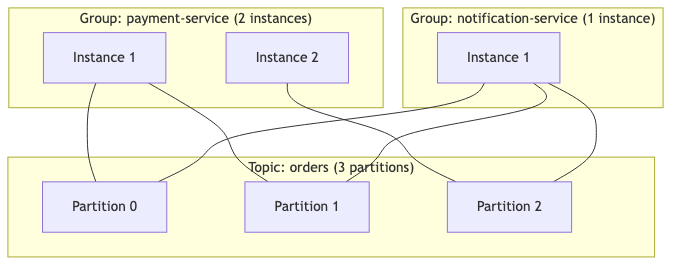
- Each consumer group gets all messages independently
- Within a group, partitions are distributed across instances
- Scaling = adding instances to a group (up to partition count)
Production Considerations
Exactly-Once Semantics
1
2
3
4
5
6
7
spring:
  kafka:
    producer:
      transaction-id-prefix: order-service-
      acks: all
    consumer:
      isolation-level: read_committed
Idempotent Consumers
Even with exactly-once, design consumers to be idempotent:
1
2
3
4
5
6
7
8
9
@KafkaListener(topics = "orders", groupId = "payment-service")
public void handleOrderCreated(OrderCreatedEvent event) {
    // Idempotency check — skip if already processed
    if (paymentRepository.existsByOrderId(event.orderId())) {
        log.info("Order {} already processed, skipping", event.orderId());
        return;
    }
    processPayment(event);
}
Monitoring
Key Kafka metrics to watch:
kafka.consumer.lag— how far behind consumers arekafka.producer.record-send-rate— throughputkafka.consumer.commit-latency— offset commit time
Common Problems
| Symptom | Cause | Fix |
|---|---|---|
| Consumer never receives messages | Wrong group-id or topic doesn’t exist | Verify topic exists, check auto-offset-reset |
DeserializationException | Producer/consumer schema mismatch | Ensure spring.json.trusted.packages is set |
| Messages processed multiple times | Consumer crashes before commit | Make consumers idempotent |
| Consumer lag growing | Processing too slow | Add consumer instances (scale out) |
| Ordering broken | Messages for same entity in different partitions | Use entity ID as message key |
TimeoutException on send | Broker unreachable | Check bootstrap-servers, network |
Full Working Example
The complete multi-module project is at github.com/AnupamSinha/spring-boot-examples/tree/main/10-kafka-microservices.
1
2
3
4
5
6
git clone https://github.com/AnupamSinha/spring-boot-examples/tree/main/10-kafka-microservices
cd spring-boot-kafka-microservices
docker compose up -d
./mvnw spring-boot:run -pl order-service
./mvnw spring-boot:run -pl payment-service
./mvnw spring-boot:run -pl notification-service