Outbox Pattern with Spring Boot + Kafka — Guaranteed Event Publishing
Solve the dual-write problem with the Transactional Outbox Pattern. Save domain events to an outbox table in the same DB transaction, then relay them to Kafka — guaranteeing at-least-once delivery without distributed transactions.
The Problem — The Dual-Write Trap
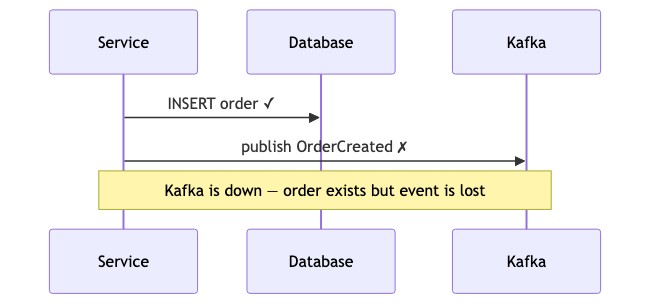
You save an order to the database, then publish an event to Kafka. Sounds simple. But what happens when one succeeds and the other fails?
sequenceDiagram
    participant Service
    participant Database
    participant Kafka

    Service->>Database: INSERT order ✓
    Service->>Kafka: publish OrderCreated ✗
    Note over Service,Kafka: Kafka is down — order exists but event is lost
Or worse:
sequenceDiagram
    participant Service
    participant Database
    participant Kafka

    Service->>Kafka: publish OrderCreated ✓
    Service->>Database: INSERT order ✗
    Note over Service,Database: DB constraint violation — event published but order doesn't exist
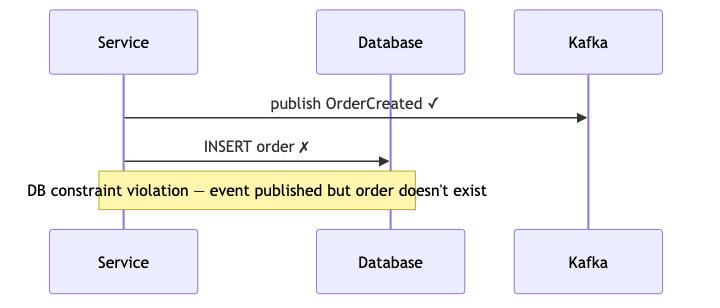
This is the dual-write problem: writing to two systems (database + message broker) without a single atomic transaction. You can’t wrap Kafka and PostgreSQL in the same transaction — they’re different systems with different transaction protocols.
Why Not Distributed Transactions (2PC)?
Two-phase commit sounds like the answer, but it’s impractical for microservices:
- Kafka doesn’t support XA transactions
- 2PC is slow (holding locks across network calls)
- A coordinator failure blocks all participants
- It doesn’t scale with many services
The Outbox Pattern
The solution is elegantly simple: don’t write to two systems. Write to one system (the database) twice — once for the domain entity, once for the event — in a single transaction.
graph LR
    subgraph "Single Database Transaction"
        A[OrderService] --> B[Save Order]
        A --> C[Save OutboxEvent]
    end
    D[OutboxRelay] -->|polls| C
    D -->|publishes| E[Kafka]
    D -->|marks published| C

    style A fill:#e1f5fe
    style B fill:#c8e6c9
    style C fill:#c8e6c9
    style D fill:#fff3e0
    style E fill:#fce4ec
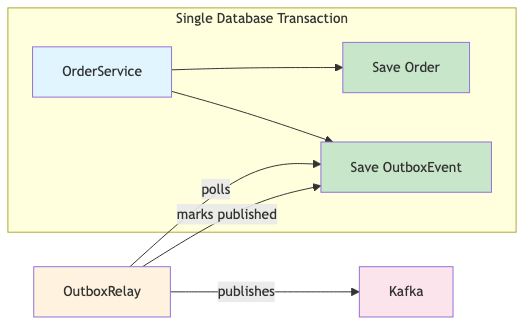
How it works:
OrderServicesaves theOrderand anOutboxEventin the same database transaction- If either fails, both are rolled back — consistency guaranteed
- A separate
OutboxRelaycomponent polls the outbox table for unpublished events - It publishes each event to Kafka
- After successful publish, it marks the event as published
This guarantees at-least-once delivery — the event will eventually be published as long as the relay keeps running.
Implementation
The Outbox Table
1
2
3
4
5
6
7
8
9
10
11
12
13
CREATE TABLE outbox_events (
    id              UUID PRIMARY KEY,
    aggregate_type  VARCHAR(255) NOT NULL,
    aggregate_id    VARCHAR(255) NOT NULL,
    event_type      VARCHAR(255) NOT NULL,
    payload         TEXT NOT NULL,
    created_at      TIMESTAMP NOT NULL DEFAULT NOW(),
    published       BOOLEAN NOT NULL DEFAULT FALSE,
    published_at    TIMESTAMP
);

CREATE INDEX idx_outbox_unpublished ON outbox_events (published, created_at)
    WHERE published = FALSE;
The JPA entity:
1
2
3
4
5
6
7
8
9
10
11
12
13
14
15
16
17
18
19
20
21
22
23
24
25
26
27
@Entity
@Table(name = "outbox_events")
public class OutboxEvent {

    @Id
    private UUID id;

    @Column(nullable = false)
    private String aggregateType;

    @Column(nullable = false)
    private String aggregateId;

    @Column(nullable = false)
    private String eventType;

    @Column(nullable = false, columnDefinition = "TEXT")
    private String payload;

    @Column(nullable = false)
    private Instant createdAt;

    @Column(nullable = false)
    private boolean published;

    private Instant publishedAt;
}
OrderService — The Atomic Write
The critical piece: both writes happen in the same @Transactional method.
1
2
3
4
5
6
7
8
9
10
11
12
13
14
15
16
17
18
19
20
21
22
23
24
25
26
27
28
29
30
31
32
33
34
35
36
37
38
39
40
41
42
43
44
45
46
47
48
49
50
51
@Service
public class OrderService {

    private final OrderRepository orderRepository;
    private final OutboxRepository outboxRepository;
    private final ObjectMapper objectMapper;

    @Transactional
    public Order createOrder(Order order) {
        // Write 1: save the domain entity
        Order savedOrder = orderRepository.save(order);

        // Write 2: save the outbox event (same transaction!)
        OutboxEvent event = new OutboxEvent(
                "Order",
                savedOrder.getId().toString(),
                "OrderCreated",
                toJson(savedOrder)
        );
        outboxRepository.save(event);

        return savedOrder;
    }

    @Transactional
    public Order confirmOrder(Long orderId) {
        Order order = orderRepository.findById(orderId)
                .orElseThrow(() -> new RuntimeException("Order not found"));

        order.setStatus(OrderStatus.CONFIRMED);
        Order savedOrder = orderRepository.save(order);

        OutboxEvent event = new OutboxEvent(
                "Order",
                savedOrder.getId().toString(),
                "OrderConfirmed",
                toJson(savedOrder)
        );
        outboxRepository.save(event);

        return savedOrder;
    }

    private String toJson(Object obj) {
        try {
            return objectMapper.writeValueAsString(obj);
        } catch (JsonProcessingException e) {
            throw new RuntimeException("Failed to serialize", e);
        }
    }
}
If the database write fails (constraint violation, connection lost), neither the order nor the event is persisted. Consistency is maintained.
OutboxRelay — The Polling Publisher
The relay runs on a schedule, picks up unpublished events, and sends them to Kafka:
1
2
3
4
5
6
7
8
9
10
11
12
13
14
15
16
17
18
19
20
21
22
23
24
25
26
27
28
29
30
31
32
@Component
public class OutboxRelay {

    private static final Logger log = LoggerFactory.getLogger(OutboxRelay.class);

    private final OutboxRepository outboxRepository;
    private final KafkaTemplate<String, String> kafkaTemplate;

    @Scheduled(fixedDelay = 5000)
    @Transactional
    public void pollAndPublish() {
        List<OutboxEvent> unpublished =
                outboxRepository.findByPublishedFalseOrderByCreatedAtAsc();

        for (OutboxEvent event : unpublished) {
            try {
                String topic = event.getAggregateType().toLowerCase() + "-events";

                kafkaTemplate.send(topic, event.getAggregateId(), event.getPayload());

                event.setPublished(true);
                event.setPublishedAt(Instant.now());
                outboxRepository.save(event);

                log.info("Published event: {} / {}", event.getEventType(), event.getId());
            } catch (Exception e) {
                log.error("Failed to publish event {}: {}", event.getId(), e.getMessage());
                break; // Stop — retry on next poll
            }
        }
    }
}
Sequence Diagram — Full Flow
sequenceDiagram
    participant Client
    participant OrderService
    participant DB
    participant OutboxRelay
    participant Kafka

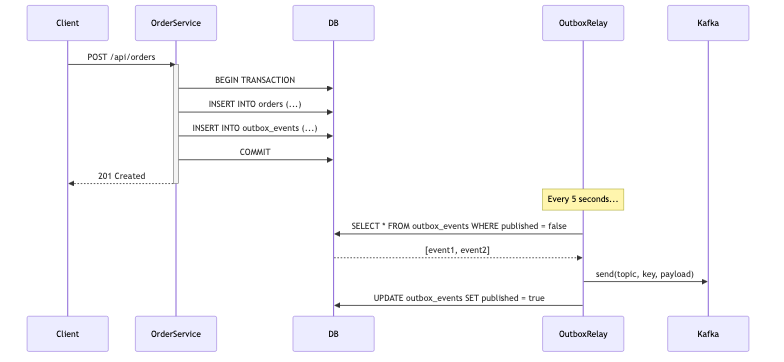
    Client->>OrderService: POST /api/orders
    activate OrderService
    OrderService->>DB: BEGIN TRANSACTION
    OrderService->>DB: INSERT INTO orders (...)
    OrderService->>DB: INSERT INTO outbox_events (...)
    OrderService->>DB: COMMIT
    OrderService-->>Client: 201 Created
    deactivate OrderService

    Note over OutboxRelay: Every 5 seconds...
    OutboxRelay->>DB: SELECT * FROM outbox_events WHERE published = false
    DB-->>OutboxRelay: [event1, event2]
    OutboxRelay->>Kafka: send(topic, key, payload)
    OutboxRelay->>DB: UPDATE outbox_events SET published = true
Idempotent Consumers
Since the outbox guarantees at-least-once delivery (not exactly-once), consumers must handle duplicates. If the relay crashes after publishing to Kafka but before marking the event as published, it will re-publish on the next poll.
Strategies for idempotency:
1
2
3
4
5
6
7
8
9
10
11
12
13
14
15
16
17
@KafkaListener(topics = "order-events")
public void handleOrderEvent(ConsumerRecord<String, String> record) {
    String eventId = record.headers()
            .lastHeader("event-id").value().toString();

    // Check if already processed
    if (processedEventRepository.existsById(eventId)) {
        log.info("Duplicate event {}, skipping", eventId);
        return;
    }

    // Process the event
    processOrder(record.value());

    // Mark as processed
    processedEventRepository.save(new ProcessedEvent(eventId, Instant.now()));
}
Polling vs CDC (Debezium)
| Aspect | Polling (this approach) | CDC with Debezium |
|---|---|---|
| Latency | Depends on poll interval (seconds) | Near real-time (milliseconds) |
| Complexity | Simple — just @Scheduled | Requires Debezium + Kafka Connect |
| Infrastructure | App + DB + Kafka | App + DB + Kafka + Kafka Connect + Debezium |
| Ordering guarantee | Within poll batch (by createdAt) | Guaranteed by WAL position |
| No outbox table needed | No — needs explicit outbox table | Can read directly from WAL |
| DB load | Periodic query on outbox table | Reads from WAL — minimal DB load |
| Cleanup | Must delete/archive old events | Events never stored in app table |
| Scaling | Single poller (or use locks) | Kafka Connect scales horizontally |
When to Use Polling
- You want simplicity — no extra infrastructure
- Event latency of a few seconds is acceptable
- You have a small to medium event volume
- Your team doesn’t have Kafka Connect expertise
When to Use CDC (Debezium)
- You need sub-second latency
- High event volume (thousands/sec)
- You want to avoid querying the outbox table
- You already run Kafka Connect in production
When to Use the Outbox Pattern
Use it when:
- You write to a database and publish events to a broker
- Exactly-once semantics between DB and broker matter
- You can’t afford lost events (payments, orders, notifications)
- You don’t want distributed transactions
Don’t use it when:
- Eventual consistency isn’t acceptable (rare)
- You only have one data store (no dual-write)
- Events are fire-and-forget (logging, analytics)
- You already use a framework that handles this (Axon, Eventuate)
Common Problems
| Problem | Cause | Solution |
|---|---|---|
| Events published out of order | Multiple relay instances running | Use a single relay or SELECT ... FOR UPDATE SKIP LOCKED |
| Duplicate events in Kafka | Relay crashes after publish, before marking published | Make consumers idempotent (deduplication table) |
| Outbox table grows forever | Old published events not cleaned up | Scheduled job to delete events older than N days |
| Relay blocked by poison event | One event always fails to serialize/publish | Add retry count, move to dead-letter after N retries |
| High DB load from polling | Poll interval too aggressive | Increase interval or switch to CDC |
| Events missing after deploy | Relay disabled during deployment window | Run relay as separate process, or ensure zero-downtime deploy |
| Transaction too large | Saving large payloads in outbox | Store minimal payload, let consumer fetch full data |
Full Working Example
The complete project is available on GitHub:
spring-boot-outbox-pattern on GitHub
1
2
3
4
git clone https://github.com/anupamsinha/spring-boot-outbox-pattern.git
cd spring-boot-outbox-pattern
docker compose up -d
./mvnw spring-boot:run
Test it:
1
2
3
4
5
6
7
8
9
10
11
12
13
14
15
# Create an order
curl -X POST http://localhost:8080/api/orders \
  -H "Content-Type: application/json" \
  -d '{
    "customerId": "cust-123",
    "productName": "Mechanical Keyboard",
    "quantity": 1,
    "totalAmount": 149.99
  }'

# Check Kafka topic (use kafka-console-consumer or kcat)
docker exec kafka /opt/kafka/bin/kafka-console-consumer.sh \
  --bootstrap-server localhost:9092 \
  --topic order-events \
  --from-beginning