Scheduling in Spring Boot — @Scheduled, Quartz, and Distributed Locks
Master job scheduling in Spring Boot. Covers @Scheduled (fixedRate, fixedDelay, cron), thread pool configuration, ShedLock for distributed environments, Quartz for complex workflows, and patterns to avoid duplicate execution across instances.
The Problem: Duplicate Jobs in Clustered Deployments
You deploy two instances of your Spring Boot app behind a load balancer. Both have @Scheduled(cron = "0 0 2 * * *") to generate a daily report. What happens at 2 AM?
Both instances execute the job. Two reports. Two emails. Two database writes.
This is the #1 surprise in production scheduling. Spring @Scheduled is instance-local — it has no awareness of other instances.
@Scheduled Basics
The simplest scheduling in Spring Boot. Add @EnableScheduling and annotate methods:
1
2
3
4
5
6
7
@SpringBootApplication
@EnableScheduling
public class SchedulingApplication {
    public static void main(String[] args) {
        SpringApplication.run(SchedulingApplication.class, args);
    }
}
fixedRate vs fixedDelay vs Cron
| Attribute | Behavior | Example | Use Case |
|---|---|---|---|
fixedRate | Next run starts N ms after previous start | @Scheduled(fixedRate = 60000) | Periodic polling (even if previous is still running) |
fixedDelay | Next run starts N ms after previous completion | @Scheduled(fixedDelay = 30000) | Dependent tasks (must finish before next starts) |
cron | Unix-style cron expression | @Scheduled(cron = "0 0 2 * * *") | Time-specific execution (daily at 2 AM) |
initialDelay | Delay before first execution | @Scheduled(fixedRate=5000, initialDelay=10000) | Wait for app warmup |
Cron Expression Cheat Sheet
| Expression | Meaning |
|---|---|
0 0 2 * * * | Daily at 2:00 AM |
0 */15 * * * * | Every 15 minutes |
0 0 9-17 * * MON-FRI | Every hour 9 AM–5 PM, weekdays |
0 0 0 1 * * | First day of every month at midnight |
0 30 6 * * MON | Every Monday at 6:30 AM |
Format: second minute hour day-of-month month day-of-week
Thread Pool Configuration: The Default Single Thread Trap
By default, Spring Boot uses a single-threaded scheduler. If one task takes 5 minutes, all other scheduled tasks are blocked for 5 minutes.
1
2
3
4
5
6
7
8
9
10
11
12
13
14
15
@Configuration
public class SchedulerConfig {

    @Bean
    public ThreadPoolTaskScheduler taskScheduler() {
        ThreadPoolTaskScheduler scheduler = new ThreadPoolTaskScheduler();
        scheduler.setPoolSize(5);
        scheduler.setThreadNamePrefix("scheduled-task-");
        scheduler.setErrorHandler(throwable ->
                log.error("Scheduled task error: {}", throwable.getMessage()));
        scheduler.setWaitForTasksToCompleteOnShutdown(true);
        scheduler.setAwaitTerminationSeconds(30);
        return scheduler;
    }
}
Rule of thumb: Set pool size to the number of concurrent scheduled tasks you expect.
Distributed Locking with ShedLock
ShedLock ensures that a scheduled task is executed at most once across all instances. It uses a shared lock store (database, Redis, etc.).
sequenceDiagram
    participant I1 as Instance 1
    participant DB as Lock Store (DB)
    participant I2 as Instance 2

    Note over I1,I2: Cron triggers at 2:00 AM
    I1->>DB: Try to acquire lock "reportGeneration"
    DB-->>I1: Lock acquired ✓
    I2->>DB: Try to acquire lock "reportGeneration"
    DB-->>I2: Lock already held ✗
    I1->>I1: Execute report generation
    Note over I2: Skips execution
    I1->>DB: Release lock (or lock_until expires)
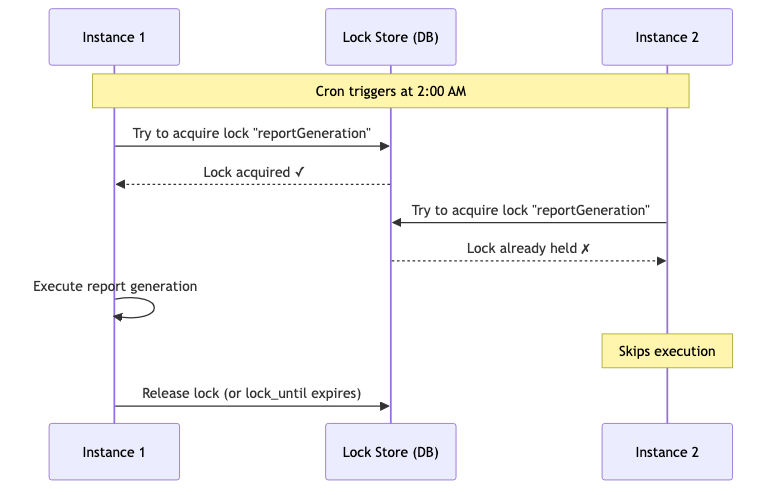
Only one instance acquires the lock. The others skip the execution entirely.
ShedLock Setup
1. Dependencies
1
2
3
4
5
6
7
8
9
10
<dependency>
    <groupId>net.javacrumbs.shedlock</groupId>
    <artifactId>shedlock-spring</artifactId>
    <version>5.13.0</version>
</dependency>
<dependency>
    <groupId>net.javacrumbs.shedlock</groupId>
    <artifactId>shedlock-provider-jdbc-template</artifactId>
    <version>5.13.0</version>
</dependency>
2. Lock Table DDL
1
2
3
4
5
6
7
CREATE TABLE IF NOT EXISTS shedlock (
    name       VARCHAR(64)  NOT NULL,
    lock_until TIMESTAMP    NOT NULL,
    locked_at  TIMESTAMP    NOT NULL,
    locked_by  VARCHAR(255) NOT NULL,
    PRIMARY KEY (name)
);
3. Configuration
1
2
3
4
5
6
7
8
9
10
11
12
13
14
@Configuration
@EnableSchedulerLock(defaultLockAtMostFor = "10m")
public class ShedLockConfig {

    @Bean
    public LockProvider lockProvider(DataSource dataSource) {
        return new JdbcTemplateLockProvider(
                JdbcTemplateLockProvider.Configuration.builder()
                        .withJdbcTemplate(new JdbcTemplate(dataSource))
                        .usingDbTime()
                        .build()
        );
    }
}
4. Annotate Tasks
1
2
3
4
5
6
7
8
9
@Scheduled(cron = "0 0 2 * * *")
@SchedulerLock(
        name = "reportGeneration",
        lockAtLeastFor = "5m",     // hold lock at least 5 min (prevent double-execution)
        lockAtMostFor = "30m"      // release lock after 30 min max (safety net)
)
public void generateDailyReport() {
    // only one instance executes this
}
lockAtLeastFor: Prevents the lock from being released too quickly. If the task finishes in 1 second, the lock is still held for 5 minutes — ensuring the other instance doesn’t also execute within the same cron trigger window.
lockAtMostFor: Safety net. If the instance crashes mid-execution, the lock expires after this duration instead of being held forever.
Quartz: When You Need More
@Scheduled is simple and stateless. When you need more, consider Quartz:
| Feature | @Scheduled | Quartz |
|---|---|---|
| Setup complexity | Minimal | Moderate (tables, config) |
| Dynamic schedules | No (compile-time only) | Yes (runtime CRUD) |
| Job persistence | None | Database-backed |
| Misfire handling | None (missed = skipped) | Configurable policies |
| Clustering | Manual (ShedLock) | Built-in |
| Job chaining/dependencies | None | Listeners and triggers |
| Job parameters | None | JobDataMap |
| Pause/resume individual jobs | None | Full lifecycle control |
When to use Quartz:
- Users configure schedules at runtime (admin panel)
- Jobs must survive restarts (persisted to DB)
- Complex misfire policies (retry, fire immediately, etc.)
- Job dependencies (Job B runs after Job A completes)
When @Scheduled + ShedLock is enough:
- Fixed schedules known at compile time
- Simple cron/rate/delay patterns
- Just need distributed lock protection
@Scheduled vs Quartz vs Spring Cloud Task
| Dimension | @Scheduled + ShedLock | Quartz | Spring Cloud Task |
|---|---|---|---|
| Deployment | In-app | In-app | Separate launcher |
| Persistence | Lock table only | Full job store | Task execution DB |
| Scaling model | Lock-based | Clustered scheduler | External trigger (K8s cron) |
| Best for | Simple periodic jobs | Complex scheduling | Cloud-native, short-lived tasks |
Monitoring Scheduled Tasks
Custom Status Endpoint
Expose last-run times via REST:
1
2
3
4
5
6
7
8
9
10
11
12
13
14
@GetMapping("/api/tasks/status")
public ResponseEntity<Map<String, Object>> getStatus() {
    Map<String, Object> status = new HashMap<>();
    status.put("reportGeneration", Map.of(
            "lastRun", reportTask.getLastRunTime() != null
                    ? reportTask.getLastRunTime().toString() : "never",
            "schedule", "cron: 0 0 2 * * * (daily at 2 AM)"
    ));
    status.put("healthCheck", Map.of(
            "lastRun", healthCheckTask.getLastRunTime().toString(),
            "serviceStatus", healthCheckTask.getServiceStatus()
    ));
    return ResponseEntity.ok(status);
}
Actuator Integration
Spring Boot Actuator exposes scheduled task info:
1
2
3
4
5
management:
  endpoints:
    web:
      exposure:
        include: scheduledtasks
1
curl http://localhost:8080/actuator/scheduledtasks
Returns all registered scheduled tasks with their configuration.
Common Problems
| Problem | Cause | Solution |
|---|---|---|
| Tasks not executing | Missing @EnableScheduling | Add to main class or config |
| Tasks blocking each other | Single-thread default | Configure ThreadPoolTaskScheduler with pool size > 1 |
| Duplicate execution in cluster | No distributed lock | Add ShedLock with @SchedulerLock |
| Task runs longer than interval | fixedRate + slow task | Use fixedDelay or add lockAtLeastFor |
| Cron not firing | Wrong cron format | Spring uses 6-field cron (includes seconds) |
| Lock never released after crash | lockAtMostFor too high or missing | Always set reasonable lockAtMostFor |
| Missed execution after downtime | @Scheduled has no misfire handling | Use Quartz if misfires must be handled |
| ShedLock table not found | DDL not applied | Add schema.sql or Flyway migration |
Full Working Example
The complete implementation is available on GitHub:
spring-boot-examples/35-scheduling
Clone and run:
1
2
3
git clone https://github.com/AnupamSinha/spring-boot-examples.git
cd spring-boot-examples/35-scheduling
./mvnw spring-boot:run
Check task status:
1
2
3
4
curl http://localhost:8080/api/tasks/status

# Manually trigger a task
curl -X POST http://localhost:8080/api/tasks/trigger/healthcheck